
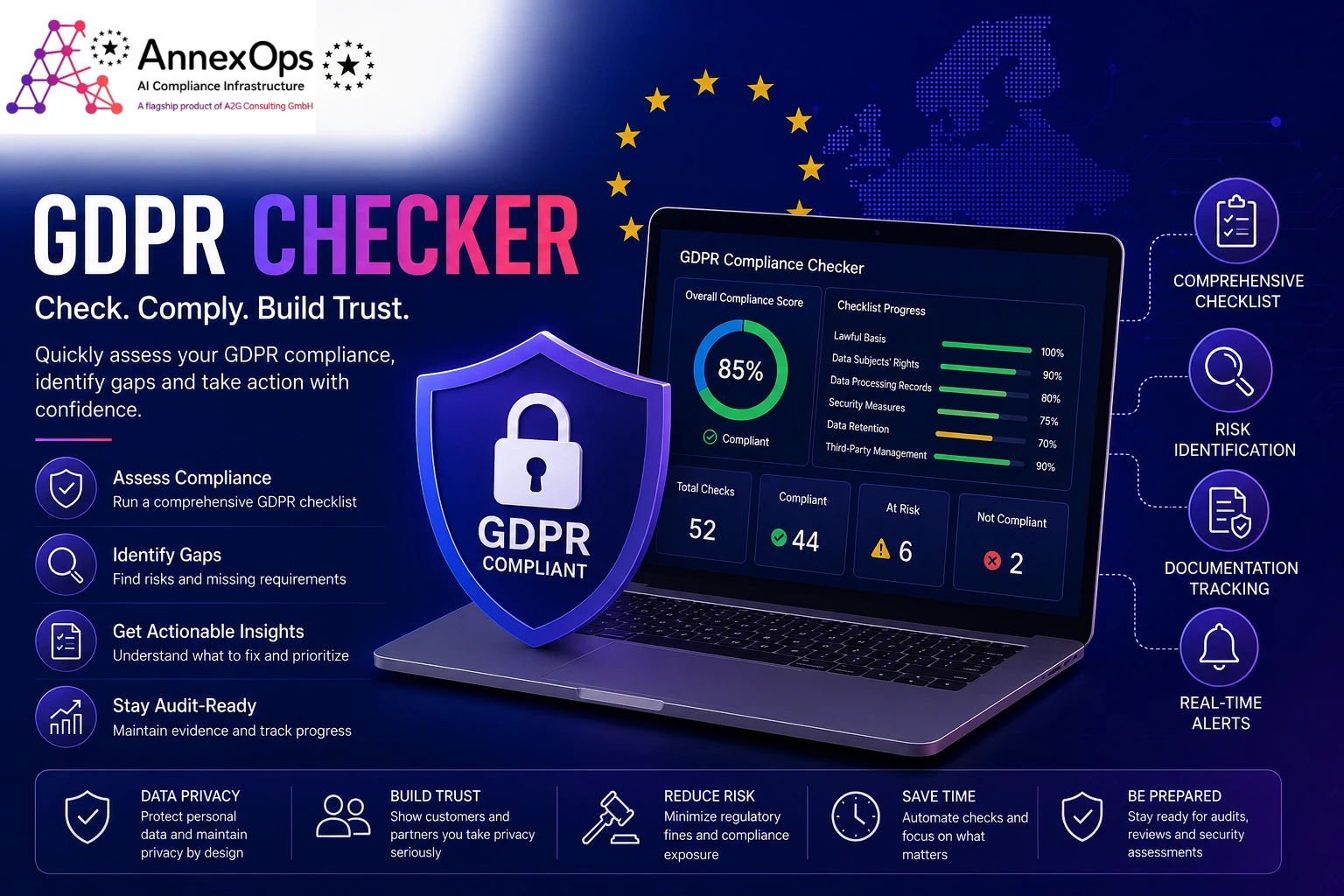
GDPR Checker: How to Verify If Your Business Is GDPR Compliant
Think your business is GDPR compliant? The real question is, can you prove it?
Many organizations believe they’re compliant because they have a privacy policy on their website or a cookie banner asking users to accept cookies. While these are important steps, GDPR compliance goes much deeper.
If an enterprise customer, business partner, or regulator asked your organization today:
- Can you demonstrate how personal data is collected and processed?
- Do you maintain accurate Records of Processing Activities (RoPA)?
- Can you respond to a Data Subject Access Request (DSAR) within the required timeframe?
- Are your data retention policies documented and consistently followed?
- Do you have evidence to support your compliance during an audit?
Would your team have clear answers, or would they spend days searching through spreadsheets, emails, and shared folders?
This is where a GDPR Checker becomes valuable.
Rather than waiting for an audit or a customer questionnaire to reveal compliance gaps, a GDPR Checker helps organizations review their privacy practices, identify areas that need attention, and improve their overall compliance posture.
For AI startups, SaaS companies, enterprise software vendors, and organizations handling personal data across Europe, regular GDPR checks are no longer just a best practice, they’re an essential part of building customer trust and maintaining operational readiness.
In this guide, we’ll explain what a GDPR Checker is, what it should assess, why regular compliance reviews matter, and how businesses can prepare for evolving governance requirements without turning compliance into a manual burden.
What Is a GDPR Checker?
A GDPR Checker is a framework, checklist, assessment process, or software solution that helps organizations evaluate whether their data privacy practices align with the requirements of the General Data Protection Regulation (GDPR).
Its purpose isn’t simply to tell you whether you’re compliant.
Instead, it helps answer important operational questions such as:
- Are we collecting personal data lawfully?
- Is customer consent properly recorded?
- Do we know where personal data is stored?
- Are our privacy policies accurate and up to date?
- Can we respond efficiently to user privacy requests?
- Do we maintain documentation required during an audit?
Think of a GDPR Checker as a health check for your organization’s privacy program.
Just as businesses perform regular security assessments to identify vulnerabilities, GDPR checks help identify weaknesses in data governance before they become regulatory or business problems.
Depending on the size and complexity of an organization, a GDPR Checker may be:
- A structured compliance checklist
- An internal assessment conducted by privacy or legal teams
- An automated compliance platform
- A governance workflow integrated into everyday business operations
Regardless of the approach, the objective remains the same: identify compliance gaps early and address them before they affect customers, audits, or business growth.
Why Regular GDPR Checks Matter
Many businesses treat GDPR compliance as a one-time project.
They update their privacy policy, configure a cookie banner, document a few internal processes, and assume the work is complete.
In reality, GDPR compliance is an ongoing responsibility.
Businesses change.
New employees join.
Customer data grows.
New software is introduced.
AI-powered tools become part of everyday operations.
Every change can affect how personal data is collected, processed, stored, or shared.
Without regular reviews, it’s easy for compliance gaps to develop over time.
For example:
- A new marketing platform begins collecting customer information without being added to your data inventory.
- A third-party vendor changes how it processes personal data.
- An outdated privacy notice no longer reflects your current practices.
- Data is retained longer than necessary because retention policies aren’t reviewed.
- Teams introduce AI features that process personal information without updating governance documentation.
None of these issues are always obvious, but they can create unnecessary compliance risks if left unchecked.
A GDPR Checker helps organizations identify these issues early, giving teams the opportunity to improve processes before they become larger problems.
Who Should Use a GDPR Checker?
Any organization that collects or processes personal data can benefit from regular GDPR assessments.
However, GDPR checks are particularly valuable for businesses operating in fast-changing environments where new technologies, products, and customer data are constantly being introduced.
This includes:
AI Startups
AI startups often process large datasets to train, test, or improve intelligent systems. Regular GDPR checks help ensure personal data is handled responsibly while supporting future AI governance initiatives.
SaaS Companies
Cloud-based software platforms collect customer information through registrations, subscriptions, analytics, and support interactions. A GDPR Checker helps verify that privacy obligations remain aligned as the platform evolves.
Enterprise Software Providers
Large organizations typically manage multiple applications, departments, and third-party integrations. Regular compliance reviews improve visibility across complex data processing activities.
Compliance and Legal Teams
Privacy professionals use GDPR assessments to review documentation, identify policy gaps, prepare for audits, and strengthen governance across the organization.
Product and Engineering Teams
As new features are released, development teams need to understand how those changes affect personal data processing. Regular compliance checks encourage privacy considerations throughout the product lifecycle.
A Real-World Example
Imagine a SaaS company that provides an AI-powered customer support platform.
Over the past year, the business has expanded into several European markets, introduced new analytics features, integrated third-party services, and hired additional employees.
The company assumes its GDPR compliance program is still effective because it completed a compliance review when the product first launched.
However, a routine GDPR check reveals several issues:
- A recently integrated analytics tool isn’t listed in the organization’s Records of Processing Activities (RoPA).
- The privacy notice hasn’t been updated to reflect new data processing activities.
- Customer data retention settings differ across business systems.
- Internal documentation for responding to Data Subject Access Requests (DSARs) is outdated.
None of these issues resulted from intentional non-compliance, they developed naturally as the business grew.
By identifying these gaps early, the company can strengthen its privacy program before they become problems during an enterprise security review or regulatory audit.
Is Your GDPR Compliance as Strong as You Think?
Many organizations don’t discover compliance gaps until an audit, enterprise procurement review, or customer request exposes them.
AnnexOps helps businesses build structured governance processes, centralize documentation, and strengthen compliance operations, making it easier to stay prepared as regulatory expectations evolve.
👉 Learn more: https://annexops.com/
📧 marketing@annexops.com
📞 +49 1522 2383606
GDPR Compliance Is No Longer Just a Legal Requirement
A few years ago, GDPR was primarily viewed as a legal and regulatory obligation.
Today, it’s also a business differentiator.
Enterprise customers increasingly evaluate privacy and governance before signing contracts.
Investors consider operational maturity as part of due diligence.
Business partners expect transparency around data handling practices.
For AI-driven organizations, strong privacy governance also creates a foundation for broader initiatives such as AI Governance, AI Risk Management, and preparation for regulations like the EU AI Act.
A GDPR Checker doesn’t just help organizations verify compliance, it helps them build confidence, improve operational resilience, and demonstrate accountability in an increasingly regulated digital landscape.
What Should a GDPR Checker Verify?
A GDPR Checker is only useful if it goes beyond surface-level checks. Simply confirming that your website has a privacy policy or a cookie banner isn’t enough to demonstrate GDPR compliance.
A thorough GDPR assessment should evaluate how your organization collects, processes, stores, shares, and protects personal data throughout its lifecycle.
Below are the key areas every business should review.
1. Privacy Policy and Transparency
Your privacy policy is often the first place customers, partners, and regulators look to understand how your organization handles personal data.
A GDPR Checker should verify that your privacy notice:
- Clearly explains what personal data is collected.
- States why the data is collected and how it will be used.
- Identifies the legal basis for processing.
- Explains how long personal data is retained.
- Lists third parties that receive personal data where applicable.
- Provides information about users’ privacy rights and how they can exercise them.
If your products, services, or data processing activities have changed, your privacy policy should reflect those updates.
2. Cookie Consent Management
Many websites rely on cookies for analytics, personalization, and marketing.
Under GDPR, organizations should obtain valid consent before placing non-essential cookies on a user’s device.
A GDPR Checker should assess whether:
- Users can accept or reject non-essential cookies.
- Consent is recorded and managed appropriately.
- Users can withdraw consent easily.
- Cookie preferences are respected during future visits.
- The cookie policy accurately reflects current technologies in use.
3. Records of Processing Activities (RoPA)
Organizations need a clear understanding of how personal data moves throughout the business.
A GDPR Checker should verify that Records of Processing Activities include:
- Categories of personal data processed.
- Processing purposes.
- Categories of data subjects.
- Third-party processors.
- Data storage locations.
- Retention periods.
- Security measures where applicable.
Maintaining accurate RoPA documentation improves visibility and supports audit readiness.
4. Data Subject Rights
GDPR gives individuals several rights regarding their personal data, including the ability to:
- Access their data.
- Correct inaccurate information.
- Request deletion (“Right to be Forgotten”).
- Restrict processing.
- Request data portability.
- Object to certain processing activities.
A GDPR Checker should confirm that your organization has documented processes for handling these requests efficiently and within regulatory deadlines.
5. Data Retention and Deletion
One of the most common compliance gaps is keeping personal data longer than necessary.
A GDPR assessment should review:
- Whether retention periods are clearly defined.
- Whether deletion processes are documented.
- Whether archived information follows retention policies.
- Whether data is removed consistently across systems.
Keeping unnecessary personal data increases both compliance and security risks.
6. Third-Party Data Processors
Most organizations rely on external vendors for cloud hosting, marketing automation, CRM platforms, payment processing, analytics, and customer support.
A GDPR Checker should identify:
- Which third parties process personal data.
- Whether appropriate contractual agreements are in place.
- Whether vendors provide adequate privacy and security protections.
- Whether international data transfers are managed appropriately.
Vendor oversight is a critical part of maintaining GDPR compliance.
7. Security Measures
Protecting personal data requires more than policies.
Organizations should regularly evaluate whether appropriate technical and organizational measures are in place.
A GDPR Checker should review:
- Access controls.
- Authentication methods.
- Encryption practices.
- Backup procedures.
- Incident response plans.
- Employee security awareness.
Strong security practices reduce risk while strengthening customer confidence.
GDPR Compliance Checklist
Use this quick checklist to assess whether your organization has the foundations of a mature GDPR compliance program.
|
Compliance Area |
Questions to Ask |
|
Privacy Policy |
Is it accurate, transparent, and up to date? |
|
Cookie Consent |
Can users manage their consent easily? |
|
RoPA |
Are processing activities documented and regularly reviewed? |
|
Data Subject Rights |
Is there a documented process for handling requests? |
|
Data Retention |
Are retention periods clearly defined and enforced? |
|
Third-Party Vendors |
Have all processors been reviewed and documented? |
|
Security Controls |
Are appropriate safeguards implemented and monitored? |
|
Compliance Documentation |
Can your team provide evidence during an audit? |
If you answered “No” or “Not Sure” to any of these questions, those areas deserve further review.
Manual GDPR Checks vs. Automated GDPR Checks
Many organizations begin with manual compliance processes because they’re easy to implement.
However, as the business grows, manual methods often become difficult to maintain.
The comparison below highlights the difference.
|
Manual GDPR Checks |
Automated GDPR Checks |
|
Multiple spreadsheets |
Centralized compliance dashboard |
|
Email approvals |
Automated governance workflows |
|
Static documentation |
Continuously updated records |
|
Manual reminders |
Automated notifications |
|
Audit preparation before reviews |
Continuous audit readiness |
|
Limited visibility |
Real-time compliance tracking |
|
Higher risk of human error |
Standardized and repeatable processes |
Automation doesn’t remove the need for compliance professionals, it gives them better tools to manage growing responsibilities efficiently.
Why Growing Businesses Are Moving Toward Automation
As organizations expand, so do the number of systems, teams, and vendors involved in processing personal data.
A startup managing customer information in one application has very different compliance needs than an enterprise operating across multiple countries with dozens of integrated platforms.
Growth introduces new challenges such as:
- Additional customer data.
- New AI-powered features.
- More third-party integrations.
- Expanding regulatory obligations.
- Larger compliance teams.
- Increased enterprise customer expectations.
Without structured processes, these changes can create documentation gaps and make compliance more difficult to manage.
This is why many organizations are moving from periodic GDPR reviews to continuous compliance supported by automation and governance workflows.
Instead of asking, “Are we compliant today?” they ask:
- How can we monitor compliance continuously?
- How do we keep documentation current as systems evolve?
- How do we reduce manual effort while maintaining accountability?
- How can we prepare for future regulations without rebuilding our compliance program?
These questions naturally lead organizations toward broader governance strategies, particularly as AI becomes a larger part of business operations.
Compliance Shouldn’t Depend on Spreadsheets
Manual processes may work for small teams, but they become increasingly difficult to manage as organizations grow.
AnnexOps helps businesses centralize documentation, streamline governance workflows, strengthen AI risk management, and maintain continuous audit readiness, helping teams stay prepared without unnecessary administrative overhead.
👉 Discover how AnnexOps supports scalable compliance operations:
📧 marketing@annexops.com
📞 +49 1522 2383606
GDPR Compliance Is the Starting Point, Not the Finish Line
Successfully completing a GDPR assessment is an important milestone, but compliance doesn’t end once every item on your checklist is marked complete.
Your business will continue to evolve.
New employees will join.
AI features will be released.
Third-party vendors will change.
Customer data volumes will grow.
Every operational change introduces new privacy and governance considerations.
That’s why leading organizations no longer treat GDPR as a one-time compliance project. Instead, they view it as part of a broader governance strategy that continuously protects personal data, manages operational risk, and builds trust with customers.
A GDPR Checker helps identify where your organization stands today, but maintaining compliance requires ongoing governance, regular reviews, and structured operational processes.
How AI Is Changing Compliance Expectations
Artificial intelligence is changing the way organizations process and use personal data.
From intelligent customer support platforms and fraud detection systems to healthcare diagnostics and recruitment software, AI applications increasingly influence business decisions and customer experiences.
As AI adoption grows, organizations face new questions beyond traditional data privacy.
For example:
- How are AI systems monitored after deployment?
- Can decisions made by AI be explained when required?
- Are AI-related risks identified and documented?
- Is there appropriate human oversight for high-impact decisions?
- Can governance evidence be produced during customer reviews or regulatory audits?
These are governance questions, not just privacy questions.
This is why businesses investing in AI should begin thinking beyond GDPR alone and start building a governance framework that supports both privacy compliance and responsible AI operations.
From GDPR Compliance to AI Governance
GDPR focuses on protecting personal data and ensuring organizations process that data lawfully and transparently.
AI Governance expands that responsibility by helping organizations manage how AI systems are developed, deployed, monitored, and maintained throughout their lifecycle.
Although GDPR and the EU AI Act are different regulations, they share several common principles:
|
GDPR Focus |
AI Governance Focus |
|
Protecting personal data |
Managing AI systems responsibly |
|
Transparency in data processing |
Transparency in AI decision-making |
|
Accountability |
Governance and oversight |
|
Risk reduction |
AI risk management |
|
Compliance documentation |
AI documentation and evidence |
|
Ongoing compliance |
Continuous monitoring and governance |
Organizations that build strong GDPR processes today are often better prepared to meet tomorrow’s AI governance expectations.
Preparing for the EU AI Act
The EU AI Act introduces additional requirements for organizations developing or deploying certain AI systems, particularly those classified as high risk.
For many businesses, preparation starts long before formal regulatory obligations apply.
Key areas include:
High-Risk AI Systems
Organizations should understand whether their AI applications fall into high-risk categories and what governance responsibilities those systems require.
AI Documentation
Comprehensive documentation helps demonstrate how AI systems are designed, tested, monitored, and maintained throughout their lifecycle.
AI Risk Management
Risk assessments should become an ongoing operational process rather than a one-time activity.
Human Oversight
Organizations should define where human review or intervention is appropriate, especially for decisions that significantly affect individuals.
Audit Readiness
Maintaining structured documentation and governance records makes responding to enterprise procurement reviews and future regulatory audits significantly easier.
Building these capabilities today helps organizations adapt more confidently as regulatory expectations continue to evolve.
How AnnexOps Helps Operationalize Compliance
As compliance obligations grow, organizations need more than policies and spreadsheets.
They need operational infrastructure that supports governance across teams, technologies, and regulatory requirements.
AnnexOps helps organizations operationalize compliance by providing a structured approach to governance rather than treating compliance as a collection of isolated documents.
With AnnexOps, organizations can:
- Centralize AI Documentation and compliance records.
- Streamline governance workflows across legal, compliance, engineering, and product teams.
- Strengthen AI Risk Management through structured processes.
- Support Annex IV documentation for organizations preparing for the EU AI Act.
- Improve audit readiness with organized compliance evidence.
- Track governance activities as AI systems evolve.
Rather than replacing existing compliance programs, AnnexOps helps organizations make those programs more scalable, transparent, and easier to manage.
For businesses preparing for enterprise procurement, expanding into European markets, or strengthening internal governance, this operational approach can reduce administrative effort while improving confidence in compliance.
Ready to Move Beyond Compliance Checklists?
A GDPR Checker helps identify compliance gaps, but long-term success depends on how effectively your organization manages governance every day.
AnnexOps helps AI-driven organizations centralize documentation, streamline governance workflows, strengthen AI risk management, and prepare for evolving regulations like the EU AI Act, all from a single operational framework.
Discover how AnnexOps can help your organization build scalable, audit-ready compliance operations:
📧 marketing@annexops.com
📞 +49 1522 2383606
Conclusion
A GDPR Checker is more than a simple compliance checklist.
It’s a practical way to evaluate whether your organization is protecting personal data, maintaining accurate documentation, and meeting its ongoing privacy responsibilities.
As businesses grow, manual compliance processes often become difficult to manage. Regular GDPR checks help identify gaps early, improve operational visibility, and strengthen customer confidence before issues arise.
For organizations building AI-powered products and services, GDPR compliance also provides the foundation for broader governance initiatives.
By combining strong privacy practices with structured AI Governance, AI Risk Management, and continuous documentation, businesses can prepare not only for today’s privacy requirements but also for future regulations such as the EU AI Act.
Ultimately, compliance isn’t just about avoiding penalties, it’s about building a business that customers, enterprise buyers, and regulators trust.
Frequently Asked Questions
What is a GDPR Checker?
A GDPR Checker is a checklist, assessment process, or software tool that helps organizations evaluate whether their data privacy practices align with GDPR requirements. It identifies potential compliance gaps and highlights areas for improvement.
How can I check if my business is GDPR compliant?
Start by reviewing your privacy policy, cookie consent, Records of Processing Activities (RoPA), data retention policies, third-party data processors, security measures, and processes for handling Data Subject Access Requests (DSARs). A GDPR Checker can help streamline this assessment.
Is a GDPR Checker the same as a GDPR audit?
No. A GDPR Checker is typically a self-assessment or ongoing compliance review, while a GDPR audit is a formal evaluation conducted internally or by an external auditor to verify compliance.
What should a GDPR Checker include?
A comprehensive GDPR Checker should assess privacy notices, cookie consent, RoPA, data subject rights, data retention, vendor management, security controls, documentation, and governance processes.
Can small businesses benefit from a GDPR Checker?
Yes. Any organization that collects or processes personal data can benefit from regular GDPR checks. Early assessments help small businesses identify compliance gaps before they become larger risks.
How often should I perform a GDPR compliance check?
It’s a good practice to review GDPR compliance at least annually and whenever significant changes occur, such as launching new products, adopting AI technologies, onboarding new vendors, or expanding into new markets.
Can GDPR compliance be automated?
Many operational compliance tasks such as documentation management, workflow tracking, audit evidence collection, and governance monitoring can be automated to improve efficiency and reduce manual effort. However, legal oversight and strategic compliance decisions still require human expertise.
How does GDPR relate to the EU AI Act?
GDPR focuses on protecting personal data, while the EU AI Act regulates how AI systems are developed, deployed, and governed. Organizations using AI may need to comply with both regulations to ensure responsible data handling and trustworthy AI practices.
Author: Nitin Grover
Nitin Grover is an AI compliance strategist and writer focused on EU AI Act compliance, AI governance, Annex IV documentation, AI risk management, and AI compliance operations for AI startups, SaaS companies, and enterprise AI teams across Europe.