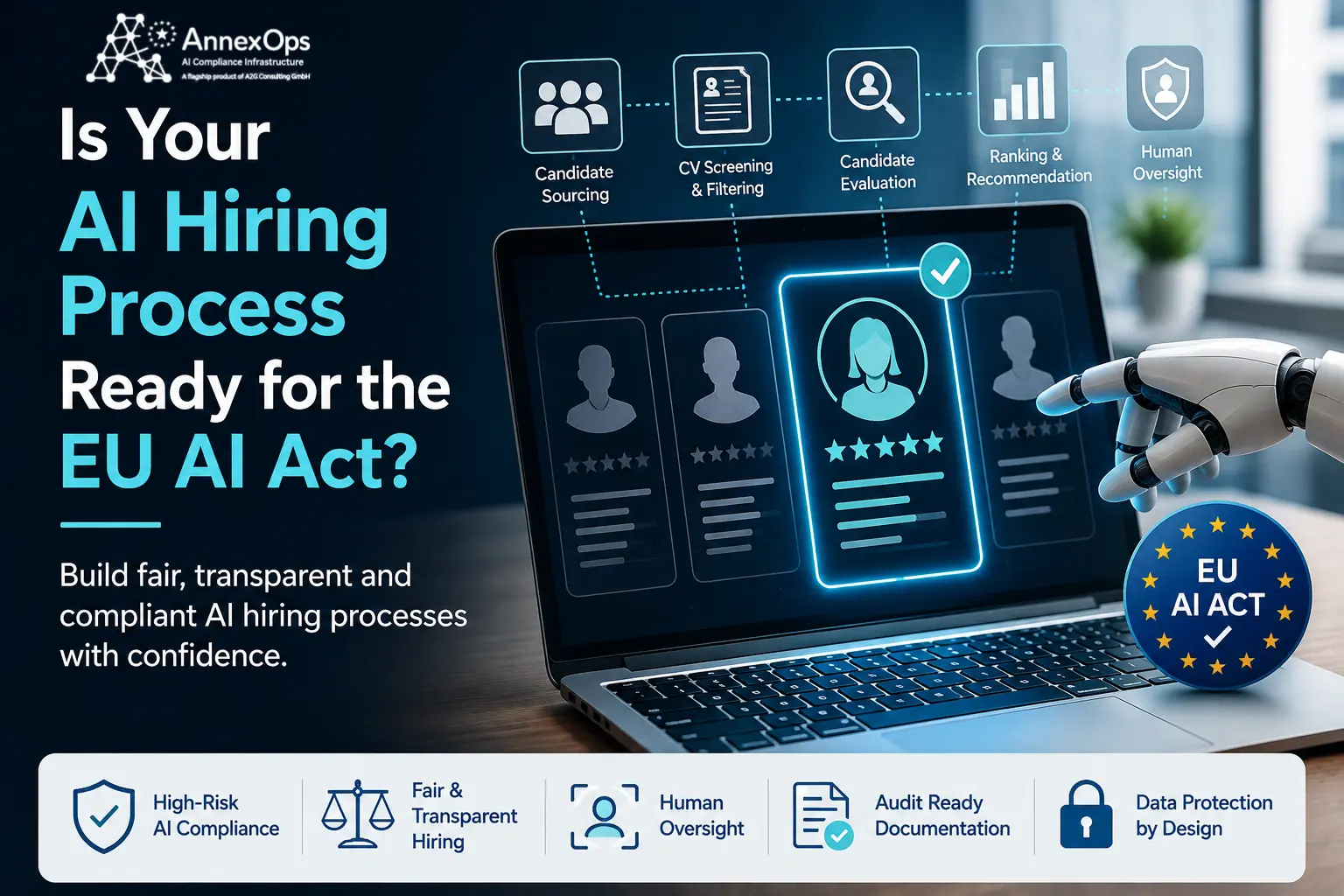
Is Your AI Hiring Process Ready for the EU AI Act?
From screening CVs and ranking candidates to targeting job advertisements and recommending who should move to the next interview stage, AI can make hiring faster and more scalable.
But there is a critical question every HR leader, CTO, AI product team, and compliance officer should now be asking:
Is your AI-powered hiring process ready for the EU AI Act?
The answer is more complicated than simply checking whether your recruitment software uses AI.
Under the EU AI Act, certain AI systems used in employment and worker management are classified as high-risk AI systems. This includes AI used for important recruitment activities such as analysing and filtering job applications and evaluating candidates.
For organisations using AI in hiring, compliance therefore needs to become part of the AI lifecycle, not something addressed after the system is deployed.
Why AI Hiring Is a High-Risk Area
Hiring decisions can directly affect a person’s career, income, and access to employment.
An AI system that ranks candidates may appear objective because it produces a score or recommendation. However, that output can still reflect problems in the underlying data, model, design, or deployment process.
For example, an AI recruitment system could:
- Rank candidates based on historical hiring patterns.
- Filter CVs using criteria that indirectly disadvantage certain groups.
- Recommend candidates based on potentially biased training data.
- Analyse interviews or assessments and influence hiring decisions.
- Target job advertisements toward particular audiences.
- Automatically rank applicants before a human recruiter reviews them.
The EU AI Act specifically identifies certain employment-related AI use cases, including targeted job advertising, application analysis and filtering, and candidate evaluation, as high-risk.
That means organisations cannot treat these systems like ordinary productivity software.
What Does the EU AI Act Mean for AI Recruitment?
The EU AI Act follows a risk-based approach.
For high-risk AI systems, organisations need to address areas such as risk management, data governance, technical documentation, record-keeping, transparency, human oversight, accuracy, robustness, and cybersecurity.
For companies deploying AI in recruitment, this creates a much broader compliance responsibility than simply selecting an AI vendor that claims to be “AI Act compliant.”
You need to understand what the AI does, what data it uses, how it affects candidates, and how decisions are controlled and documented.
1. Start With AI System Classification
The first question should be:
What exactly is our AI hiring system doing?
“AI recruitment software” is too broad a description for compliance purposes.
Create an inventory of the AI systems involved in your recruitment workflow and document their specific use cases.
For example:
| Recruitment Activity | Potential AI Use |
|---|---|
| Job advertising | Candidate targeting |
| CV screening | Application filtering |
| Candidate ranking | Automated prioritisation |
| Assessment | Candidate evaluation |
| Interview analysis | Candidate assessment |
| Candidate recommendation | Hiring recommendation |
| Workforce management | Employee evaluation |
The classification should be based on the system’s intended purpose and actual use, rather than simply its product name.
The European Commission’s draft high-risk classification guidelines specifically aim to help providers and deployers determine whether AI systems fall within the high-risk categories.
2. Know What Data Your Hiring AI Uses
AI hiring systems are only as reliable as the data and processes behind them.
Ask:
- What candidate data enters the system?
- Where does the data come from?
- What historical hiring data was used to train or configure the system?
- Are there proxy variables that could introduce discriminatory outcomes?
- How is candidate data validated?
- How long is candidate information retained?
- Who can access the data?
- Can inappropriate or outdated data be removed?
Data governance is particularly important because historical recruitment data may contain historical biases.
An AI system can reproduce those patterns at scale even when nobody intentionally programmed discriminatory rules into it.
3. Test for Bias and Discriminatory Outcomes
A recruitment model should not be considered trustworthy simply because it performs well technically.
It should also be evaluated for potential discriminatory outcomes.
Organisations should establish processes to test whether AI-generated recommendations disproportionately disadvantage candidates based on protected or otherwise sensitive characteristics.
This requires more than a one-time test.
AI models can change because of:
- Model updates
- Training-data changes
- Vendor changes
- New recruitment criteria
- Changes in candidate populations
- Changes in how recruiters use the system
A strong governance process therefore treats fairness testing as an ongoing activity.
4. Keep Humans in the Decision Loop
One of the biggest risks in AI recruitment is allowing an algorithmic recommendation to become an invisible final decision.
For example:
AI gives Candidate A a score of 92 and Candidate B a score of 64.
If the recruiter simply accepts the ranking without understanding its limitations, the “human decision” may effectively become an automated decision.
Human oversight should therefore be meaningful.
Recruiters and decision-makers should understand:
- What the AI system is designed to do.
- What its limitations are.
- When its recommendation should not be trusted.
- How to challenge or override an AI recommendation.
- When additional human review is required.
The objective is not to remove humans from AI-assisted recruitment.
It is to make sure humans remain capable of exercising effective oversight.
5. Maintain Technical Documentation
Another important question is:
Can you explain how your AI hiring system is being used?
If an organisation cannot answer basic questions about its recruitment AI, compliance becomes difficult.
Documentation should cover areas such as:
- AI system identification
- Intended purpose
- Use case
- Model or system provider
- Data sources
- Data processing
- Risk assessments
- Testing results
- Performance metrics
- Bias and fairness assessments
- Human oversight controls
- Security controls
- System changes and updates
- Incidents and corrective actions
Documentation should not exist only in a compliance folder.
It should become part of the operational lifecycle of the AI system.
6. Create an AI Hiring Audit Trail
Imagine a candidate challenges a recruitment decision six months after the hiring process.
Can your organisation reconstruct what happened?
You may need to know:
Which AI system was used?
What version was running?
What data was processed?
What recommendation did the system produce?
Who reviewed the recommendation?
Was the recommendation overridden?
What ultimately influenced the hiring decision?
Without appropriate records, proving that an AI system was governed responsibly can become extremely difficult.
An audit trail therefore becomes an important component of AI governance.
7. Don’t Forget the AI Vendors
Many companies assume that AI compliance is the vendor’s responsibility.
That can be a dangerous assumption.
Your recruitment platform may be provided by a third party, but your organisation may still have responsibilities as the deployer of the AI system.
Before adopting an AI recruitment solution, organisations should ask vendors questions such as:
- What AI models are being used?
- What is the intended purpose?
- Is the system classified as high-risk?
- What documentation is available?
- What testing has been performed?
- How is bias evaluated?
- How are model updates communicated?
- What monitoring capabilities are available?
- What information can the customer access for compliance purposes?
- How are incidents handled?
A vendor’s statement such as “EU AI Act ready” should not replace your own compliance assessment.
8. Build an AI Recruitment Governance Framework
Compliance should not depend on one HR manager remembering to check an AI tool.
A structured governance framework should define:
Who owns the AI system?
Who approves its use?
Who assesses its risks?
Who monitors performance?
Who reviews bias and fairness?
Who handles incidents?
Who maintains documentation?
Who reviews vendor changes?
This creates accountability across HR, IT, legal, compliance, security, and business teams.
A Practical AI Hiring Compliance Checklist
Before deploying or continuing to use AI in recruitment, ask:
-
Have we inventoried all AI systems used in recruitment?
-
Have we documented each AI system’s intended purpose?
-
Have we assessed whether the system falls into a high-risk use case?
-
Do we know what candidate data the system processes?
-
Have we assessed the quality and relevance of the data?
-
Have we tested for bias and discriminatory outcomes?
-
Are meaningful human oversight controls in place?
-
Can recruiters challenge or override AI recommendations?
-
Are system decisions and relevant events recorded?
-
Do we maintain appropriate technical and compliance documentation?
-
Have we assessed our AI vendors?
-
Do we have a process for monitoring model changes?
-
Do we have an incident management process?
-
Can we demonstrate how the system is governed?
If several answers are “No” or “We don’t know,” your organisation may have a significant AI governance gap.
The 2027 Deadline Is Not a Reason to Wait
There is an important update to the EU AI Act timeline.
Following the AI Omnibus agreement that entered into force in July 2026, the rules for high-risk AI systems in areas including employment are scheduled to apply from 2 December 2027.
That additional time should not be interpreted as permission to postpone AI governance.
Building an AI inventory, classifying systems, reviewing vendors, testing models, establishing documentation, and implementing governance controls can take considerable time—especially for enterprises with multiple HR platforms and AI tools.
The organisations that start early will have more time to identify gaps and fix them before compliance becomes a deadline-driven exercise.
Compliance Should Be Continuous, Not a One-Time Project
AI hiring systems are not static.
Models change.
Vendors release new versions.
Recruitment teams change how they use technology.
New data sources are introduced.
Business processes evolve.
Therefore, AI compliance cannot be treated as a one-time certification exercise.
Organisations need a continuous process:
Discover → Classify → Assess → Govern → Monitor → Document → Improve
This approach helps organisations keep compliance connected to the actual AI lifecycle.
How AnnexOps Can Help
Managing AI compliance manually across multiple systems, teams, and documentation repositories can quickly become difficult.
AnnexOps is designed to help organisations operationalise AI governance and EU AI Act compliance by bringing AI systems, risk assessments, documentation, controls, and compliance activities into a structured workflow.
For AI-enabled recruitment, an organisation can use an AI governance platform to establish greater visibility into:
- Which AI systems are being used.
- Where they are being used.
- What risks they create.
- What controls are required.
- What documentation needs to be maintained.
- What assessments have been completed.
- What compliance gaps remain.
- What actions require attention.
The goal is simple:
Don’t wait until an AI system becomes a compliance problem. Build governance into the AI lifecycle from the beginning.
Final Thoughts
AI can make recruitment faster, more scalable, and potentially more consistent, but automation does not automatically mean fairness, transparency, or compliance.
If your organisation uses AI to target job advertisements, screen applications, rank candidates, evaluate applicants, or influence employment decisions, you should understand exactly how that AI fits within the EU AI Act.
The most important question is no longer:
“Are we using AI in hiring?”
It is:
“Can we demonstrate that our AI hiring process is governed, controlled, documented, and compliant?”
For organisations building AI-powered recruitment processes in Europe, now is the time to start answering that question.