Why AI Compliance Requires Cross-Functional Operations
Artificial intelligence is no longer an experimental technology confined to innovation labs. It has become a critical business capability influencing customer experiences, operational efficiency, risk management, hiring decisions, financial services, healthcare outcomes, and countless enterprise processes.
As AI adoption accelerates, regulatory expectations are evolving just as rapidly. The EU AI Act represents one of the most significant regulatory developments in the global AI landscape, introducing clear requirements for organizations developing, deploying, or using AI systems within the European market.
For many organizations, compliance is initially viewed as a legal responsibility. However, companies preparing for the EU AI Act are discovering a more complex reality: successful compliance cannot be achieved by legal teams alone.
AI compliance operations have become a cross-functional business discipline that requires coordination between engineering, product management, security, compliance, legal, risk management, and executive leadership. As regulatory expectations grow, AI compliance operations are becoming essential for organizations seeking scalable governance and sustainable compliance.
Organizations that recognize this shift early will be better positioned to scale AI responsibly, maintain enterprise trust, accelerate procurement cycles, and reduce regulatory risk.
The Compliance Challenge Is No Longer Just Regulatory
The EU AI Act introduces a risk-based framework for governing AI systems. Depending on how AI is used and its potential impact on individuals and society, organizations may face significant obligations around documentation, transparency, oversight, monitoring, and risk management.
For companies building or deploying high-risk AI systems, compliance becomes an operational challenge rather than simply a legal exercise.
Requirements such as:
- Annex IV documentation
- Risk assessments
- Transparency requirements
- Human oversight mechanisms
- Data governance controls
- Continuous monitoring processes
- Incident reporting procedures
- Record-keeping obligations
must be maintained across multiple business functions.
The challenge is that the information required to demonstrate compliance often resides in different departments.
| Compliance Requirement | Primary Contributors |
| Annex IV Documentation | Product, Engineering, Compliance |
| Risk Management | Risk, Security, Product Teams |
| Human Oversight Procedures | Operations, Product, Legal |
| Transparency Requirements | Product, UX, Legal |
| Monitoring & Logging | Engineering, Security |
| Audit Readiness | Compliance, Leadership, Operations |
This fragmentation is one of the biggest obstacles organizations face when preparing for the EU AI Act.
Why Traditional Compliance Approaches Fall Short
Many organizations still manage governance activities using spreadsheets, shared drives, emails, and disconnected review processes.
While these methods may work for occasional compliance projects, they quickly become unsustainable as AI systems scale.
Common issues include:
Documentation Silos
Engineering teams maintain technical documentation.
Legal teams manage policies.
Compliance teams track assessments.
Product teams maintain requirements.
When these artifacts remain disconnected, creating a complete compliance record becomes difficult.
Inconsistent Risk Assessments
Without standardized governance workflows, risk evaluations often vary between teams.
This inconsistency creates uncertainty around:
- AI risk management
- Classification decisions
- Control implementation
- Compliance evidence
Limited Visibility
Leadership frequently lacks visibility into:
- Which AI systems are in production
- Which systems may be classified as high-risk AI systems
- Compliance status across business units
- Documentation gaps
Without centralized oversight, compliance becomes reactive.
Audit Preparation Becomes Expensive
Organizations often discover documentation gaps only when preparing for audits, enterprise procurement reviews, or regulatory inquiries.
This results in rushed documentation efforts, duplicated work, and increased operational costs.
The Real-World Operational Challenges Behind AI Governance
The EU AI Act requires organizations to think differently about governance.
AI governance is not a one-time approval process.
It is an ongoing operational function.
Consider a common enterprise scenario.
A SaaS company launches an AI-powered recommendation engine. Over time:
- New models are introduced.
- Training datasets evolve.
- Product functionality expands.
- Third-party AI providers are integrated.
- Risk profiles change.
Every change may impact compliance obligations.
If governance processes are not embedded into daily operations, organizations struggle to maintain compliance over time.
This is where AI compliance operations become essential.
Instead of treating compliance as a periodic review, organizations must create repeatable governance processes that support continuous oversight.
Why Cross-Functional Operations Are Becoming Essential
The most successful AI organizations are building governance programs that operate similarly to cybersecurity or quality management systems.
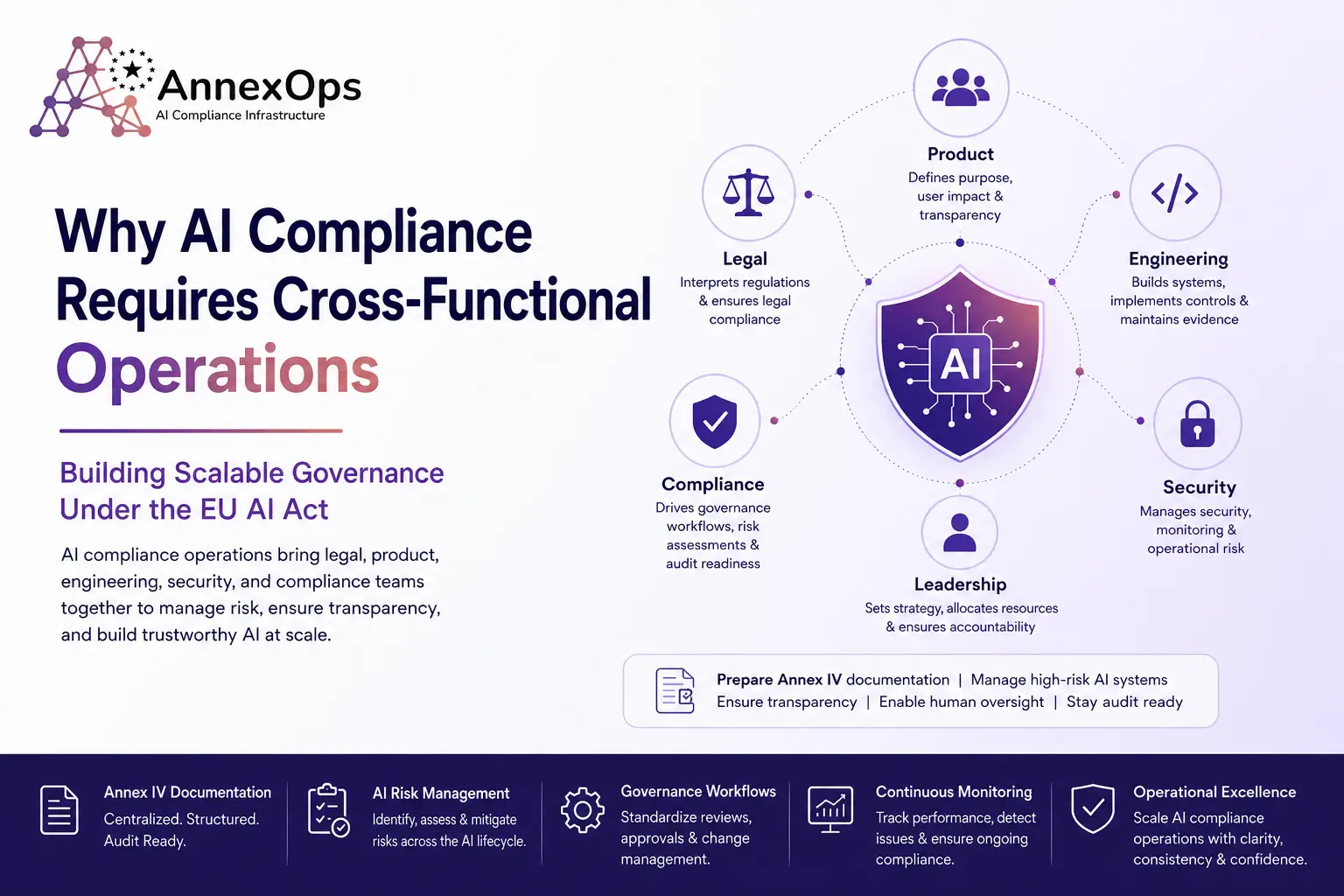
Compliance is becoming a shared responsibility.
Legal Teams Provide Regulatory Interpretation
Legal teams help organizations understand:
- EU AI Act obligations
- Regulatory updates
- Contractual requirements
- Enterprise procurement expectations
Product Teams Define System Behavior
Product leaders understand:
- Intended system purpose
- User interactions
- Decision-making impacts
- Transparency obligations
Engineering Teams Maintain Technical Evidence
Engineering teams manage:
- Model development processes
- Monitoring systems
- Logging capabilities
- Technical controls
Compliance Teams Coordinate Governance
Compliance professionals oversee:
- Risk assessments
- Documentation management
- Internal reviews
- Audit readiness activities
Leadership Establishes Accountability
Executives ensure:
- Governance ownership
- Resource allocation
- Risk tolerance decisions
- Organizational alignment
Without cross-functional collaboration, governance efforts often become fragmented and difficult to scale.
The Business Impact of Effective AI Compliance Operations
Organizations frequently focus on compliance as a cost center.
However, mature AI compliance operations generate measurable business value.
Faster Enterprise Procurement
Large enterprises increasingly evaluate vendors based on governance maturity.
Companies that can quickly provide:
- Risk assessments
- Governance documentation
- Transparency information
- Compliance evidence
often accelerate procurement processes.
Improved Customer Trust
Trustworthy AI is becoming a competitive differentiator.
Customers increasingly want assurance that AI systems are:
- Reliable
- Explainable
- Monitored
- Governed responsibly
Organizations with mature governance programs can demonstrate these capabilities more effectively.
Reduced Operational Risk
Structured governance workflows help identify:
- Documentation gaps
- Control weaknesses
- Process failures
- Emerging risks
before they become larger compliance issues.
Better Scalability
As AI portfolios expand, manual governance processes become unsustainable.
Operationalized compliance enables organizations to scale innovation while maintaining oversight.
The Enterprise Market Is Raising Expectations
The regulatory environment is only part of the story.
Enterprise procurement teams are becoming increasingly sophisticated in how they evaluate AI vendors.
Many procurement reviews now include questions about:
- AI governance frameworks
- Risk management processes
- Human oversight procedures
- Documentation practices
- Transparency controls
- Monitoring capabilities
In many cases, governance maturity influences purchasing decisions even before formal regulatory requirements apply.
Organizations that invest in governance today are often better positioned to compete in enterprise markets tomorrow.
Building an Effective AI Governance Strategy
Successful organizations are moving beyond policy creation and focusing on operational execution.
An effective AI governance strategy should include five key components.
1. AI Inventory Management
Organizations should maintain a centralized inventory of AI systems.
This creates visibility into:
- AI use cases
- Risk classifications
- Ownership assignments
- Lifecycle status
2. Standardized Risk Management
Consistent AI risk management processes ensure that teams evaluate systems using common criteria.
Benefits include:
- Better decision-making
- Improved accountability
- Reduced inconsistencies
- Stronger compliance outcomes
3. Structured Documentation Workflows
Documentation should be generated and maintained through repeatable processes rather than ad hoc efforts.
This is especially important for organizations that must prepare Annex IV documentation under the EU AI Act.
4. Continuous Monitoring
Compliance does not end after deployment.
Organizations should establish ongoing monitoring programs covering:
- Performance changes
- Risk indicators
- Operational incidents
- Model updates
5. Audit Readiness by Design
Preparing for audits should be a continuous process rather than a last-minute project.
Governance evidence should be collected and maintained throughout the AI lifecycle.
Operational Best Practices for Compliance Teams
Organizations preparing for the EU AI Act can strengthen governance programs by adopting several operational best practices.
Create Clear Ownership Structures
Define responsibilities across:
- Product
- Engineering
- Legal
- Compliance
- Risk teams
Standardize Governance Workflows
Develop repeatable procedures for:
- Risk assessments
- Documentation reviews
- Model approvals
- Change management
Centralize Compliance Records
Maintain a single source of truth for:
- Assessments
- Policies
- Documentation
- Governance decisions
Embed Governance Into Development Processes
Compliance activities should become part of existing workflows rather than separate projects.
Measure Governance Performance
Track indicators such as:
- Documentation completion rates
- Review cycle times
- Risk assessment coverage
- Audit readiness status
How AnnexOps Helps Organizations Operationalize Compliance
As AI systems become more complex, organizations need operational infrastructure that supports governance at scale.
AnnexOps helps companies move beyond fragmented compliance processes by providing a structured foundation for AI compliance operations.
Rather than treating governance as a collection of isolated activities, AnnexOps enables organizations to operationalize compliance through:
- Structured governance workflows
- Centralized documentation management
- AI risk management processes
- Governance tracking and accountability
- Audit readiness support
- Annex IV documentation management
- Continuous compliance monitoring
This approach helps teams create repeatable governance processes that can evolve alongside their AI systems and regulatory obligations.
For growing AI companies, the challenge is rarely understanding that compliance matters.
The challenge is building the operational systems required to manage compliance consistently across teams and throughout the AI lifecycle.
Conclusion: Compliance Is Becoming an Operational Discipline
Organizations that invest in mature AI compliance operations today will be better prepared for future regulatory requirements, enterprise procurement expectations, and long-term AI governance success.
The organizations that succeed under the EU AI Act will not be those that simply produce documentation before a deadline.
They will be the organizations that embed governance into daily operations.
The future of AI governance is cross-functional, continuous, and operational.
Legal teams, product leaders, engineers, compliance professionals, and executives all play critical roles in creating trustworthy AI systems that meet regulatory expectations and enterprise standards.
As AI adoption continues to accelerate, AI compliance operations will become a defining capability for organizations seeking to scale responsibly, build customer trust, and compete in increasingly regulated markets.
Compliance is no longer a side project.
It is becoming core business infrastructure.
Call to Action
Learn how AnnexOps helps AI-driven companies prepare for the EU AI Act with clarity and confidence.
FAQ
What are AI compliance operations?
AI compliance operations refer to the processes, workflows, systems, and governance activities used to manage regulatory compliance across the AI lifecycle. This includes documentation, risk assessments, monitoring, audit readiness, and governance tracking.
Why does the EU AI Act require cross-functional collaboration?
The EU AI Act requires information and controls from multiple departments, including legal, engineering, product, compliance, security, and leadership teams. No single function typically owns all compliance requirements.
What are high-risk AI systems under the EU AI Act?
High-risk AI systems are applications that may significantly affect individuals’ rights, safety, or opportunities. These systems are subject to stricter obligations around documentation, transparency, risk management, human oversight, and monitoring.
What is Annex IV documentation?
Annex IV documentation is the technical documentation required for certain AI systems under the EU AI Act. It helps demonstrate compliance by documenting system design, functionality, risk controls, performance characteristics, and governance measures.
Why is audit readiness important for AI companies?
Audit readiness helps organizations respond efficiently to regulatory reviews, customer due diligence requests, enterprise procurement evaluations, and internal governance assessments.
Author: Nitin Grover
Nitin Grover is an AI compliance strategist and writer focused on EU AI Act compliance, AI governance, Annex IV documentation, AI risk management, and AI compliance operations for AI startups, SaaS companies, and enterprise AI teams across Europe.




Nitin Grover
Nitin Grover is a Compliance Manager at AnnexOps, specializing in EU AI Act compliance, AI governance, and risk management. He helps organizations build audit-ready and compliant AI systems across Europe.