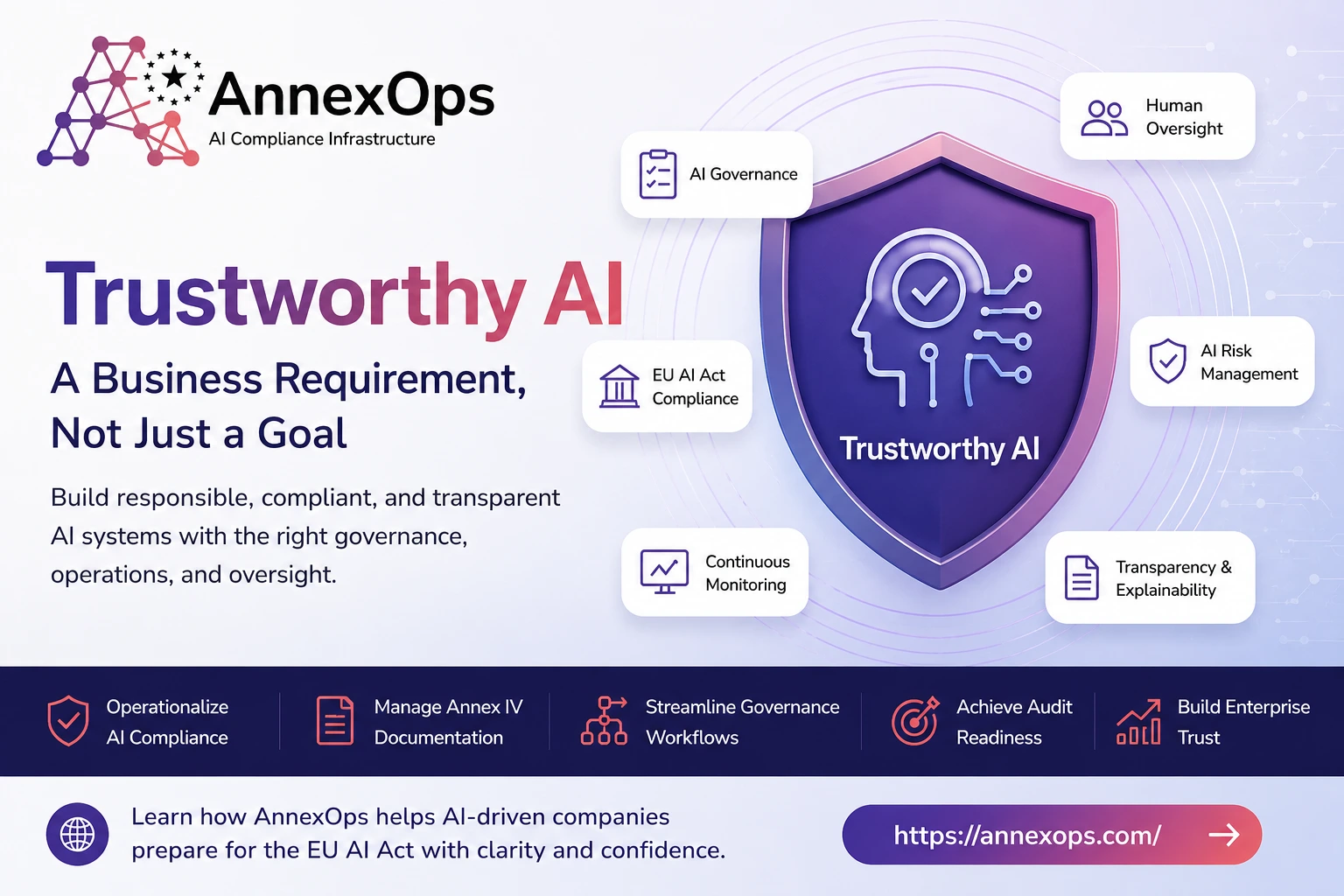
Trustworthy AI Is Becoming a Business Requirement
AI Innovation Alone Is No Longer Enough
Artificial intelligence is transforming industries at an unprecedented pace. Organizations are using AI to automate business processes, improve customer experiences, enhance operational efficiency, and develop entirely new products and services.
However, as AI becomes embedded in critical business functions, expectations are changing.
Enterprise customers, regulators, investors, and business partners are no longer asking only whether an AI solution is accurate or innovative. They also want to know whether it is responsible, transparent, secure, and governed effectively.
In other words, they want trustworthy AI.
What was once considered a competitive advantage is quickly becoming a business requirement.
Organizations that fail to demonstrate responsible AI practices may encounter procurement delays, increased regulatory scrutiny, reputational risks, and reduced customer confidence. On the other hand, companies that operationalize governance are building stronger relationships with enterprise customers while preparing for evolving regulations such as the EU AI Act.
This shift is redefining how AI products are built, deployed, and managed.
Today, trustworthy AI is no longer just a technology objective. It is becoming an operational capability that supports innovation, compliance, and sustainable business growth.
Why the Business Landscape Is Changing
AI adoption continues to accelerate across sectors including healthcare, financial services, manufacturing, retail, education, human resources, and cybersecurity.
Organizations increasingly depend on AI to make decisions that affect customers, employees, and business operations.
As these systems become more influential, stakeholders naturally expect greater accountability.
Enterprise procurement teams now evaluate vendors using questions such as:
- How is AI governed?
- What controls exist for high-risk AI systems?
- How are AI risks identified and managed?
- Is technical documentation available?
- How is human oversight maintained?
- Can governance activities be demonstrated during an audit?
These questions illustrate a broader shift in enterprise buying behavior.
AI performance remains important, but governance maturity has become equally valuable.
Organizations capable of demonstrating trustworthy AI principles often build confidence more quickly during procurement and due diligence.
Problem Overview: Why Many Organizations Struggle
Although most AI companies recognize the importance of governance, many continue to manage compliance using fragmented processes.
Engineering teams build AI systems.
Compliance teams manage documentation.
Legal departments interpret regulations.
Security teams conduct assessments.
Product teams coordinate releases.
Each department contributes valuable work, yet governance information often remains scattered across emails, spreadsheets, shared folders, and disconnected software platforms.
This fragmentation creates operational challenges including:
- Duplicate documentation
- Limited visibility
- Inconsistent governance reviews
- Delayed approvals
- Increased compliance effort
- Longer enterprise procurement cycles
As organizations scale AI initiatives, these inefficiencies become increasingly difficult to manage.
Without structured governance, maintaining trustworthy AI becomes significantly more challenging
Real-World Operational Challenges
Governance Often Exists Outside Engineering
One of the most common governance problems is separation between engineering and compliance.
Engineering teams focus on developing models and deploying applications.
Compliance teams focus on regulatory requirements.
Legal teams focus on interpretation.
Because these activities occur independently, governance frequently becomes reactive.
Organizations scramble to collect documentation only after customers request evidence or regulators begin asking questions.
This reactive approach increases operational costs while slowing innovation.
Building trustworthy AI requires governance to become part of everyday engineering workflows rather than a separate compliance project.
AI Risk Management Is Frequently Manual
Effective AI risk management requires continuous evaluation rather than occasional assessments.
Yet many organizations still rely on manual reviews performed only during product releases or customer audits.
This creates several risks:
- Emerging issues remain undetected.
- Documentation becomes outdated.
- Governance decisions are difficult to trace.
- Audit preparation consumes significant resources.
Organizations that operationalize AI risk management through structured governance processes are generally better prepared to support both compliance and enterprise procurement.
High-Risk AI Systems Require Greater Oversight
The EU AI Act introduces additional obligations for high-risk AI systems that influence important decisions.
Examples include AI used in:
- Recruitment and hiring
- Credit scoring
- Healthcare
- Education
- Critical infrastructure
- Law enforcement
- Public services
Organizations developing these systems may need to demonstrate:
- Transparency requirements
- Human oversight
- Risk management processes
- Technical documentation
- Continuous monitoring
- Audit readiness
These obligations reinforce why trustworthy AI is becoming central to both regulatory compliance and business success.
Documentation Becomes Difficult to Scale
As AI portfolios expand, documentation quickly becomes one of the biggest governance challenges.
Organizations must often maintain Annex IV documentation, governance records, model information, risk assessments, monitoring activities, and compliance evidence across multiple AI systems.
Without centralized governance, documentation rapidly becomes inconsistent.
Enterprise customers increasingly expect vendors to produce accurate documentation during procurement rather than creating it after requests are received.
This operational expectation highlights why governance must evolve from manual administration into structured AI compliance operations.
Business Impact: Why Trustworthy AI Creates Competitive Advantage
Organizations often view AI governance as a compliance obligation. In reality, it has become a business strategy.
Companies that can demonstrate trustworthy AI are increasingly building stronger relationships with enterprise customers, reducing procurement friction, and accelerating business growth.
Trust has become one of the most valuable assets in enterprise AI.
As AI systems influence business-critical decisions, customers expect vendors to prove that governance is operational—not just documented.
Organizations that establish governance maturity are better positioned to:
- Win enterprise contracts
- Reduce procurement delays
- Strengthen customer confidence
- Improve audit readiness
- Minimize operational risk
- Support long-term AI adoption
Rather than slowing innovation, governance enables organizations to scale AI responsibly.
Enterprise Procurement Expectations Are Evolving
Enterprise procurement teams have significantly expanded their evaluation criteria for AI vendors.
Instead of assessing only product functionality, buyers now evaluate governance capabilities before approving AI solutions.
Typical procurement questions include:
- How are AI systems governed?
- How do you perform AI risk management?
- Is technical documentation maintained?
- How are governance decisions recorded?
- Can you demonstrate continuous monitoring?
- How is human oversight implemented?
- Are you prepared for EU AI Act compliance?
Organizations that answer these questions with documented operational processes often establish greater credibility during enterprise procurement.
This is one of the primary reasons trustworthy AI is becoming a commercial advantage.
Why Trustworthy AI Influences Enterprise Sales
Enterprise customers invest in long-term technology partnerships.
They want assurance that vendors can support evolving regulations while maintaining reliable governance practices.
Organizations demonstrating trustworthy AI often experience:
Faster Procurement Reviews
Governance documentation is already available.
Compliance evidence can be shared quickly.
Enterprise buyers spend less time requesting additional information.
Stronger Customer Trust
Customers gain confidence when organizations demonstrate:
- Transparency
- Accountability
- Responsible AI practices
- Governance maturity
- Operational consistency
Trust becomes easier to establish when governance activities are visible rather than assumed.
Reduced Compliance Risk
Organizations with structured governance can identify issues earlier.
Continuous AI risk management reduces operational surprises while improving regulatory preparedness.
Instead of reacting to audits, organizations remain prepared throughout the AI lifecycle.
Improved Enterprise Reputation
Responsible AI increasingly influences brand perception.
Organizations recognized for trustworthy AI often strengthen relationships with:
- Enterprise customers
- Investors
- Regulators
- Strategic partners
- Procurement teams
Governance maturity contributes directly to long-term business credibility.
AI Governance Strategy for Modern Organizations
Building trustworthy AI requires governance that operates continuously rather than periodically.
Organizations should focus on operational execution across every stage of the AI lifecycle.
1. Create Centralized Governance
Governance information should not remain isolated across departments.
Organizations benefit from centralized visibility into:
- AI inventories
- Risk assessments
- Documentation
- Governance approvals
- Monitoring activities
- Compliance evidence
Centralization reduces duplication while improving accountability.
2. Implement Governance Workflows
Structured governance workflows transform governance into repeatable operational processes.
Effective workflows support:
AI Inventory Management
Maintain visibility into every AI system deployed across the organization.
Risk Classification
Identify whether systems qualify as high-risk under the EU AI Act.
Governance Reviews
Standardize approvals across engineering, legal, product, and compliance teams.
Documentation Management
Maintain current technical documentation throughout the AI lifecycle.
Monitoring
Support continuous monitoring rather than periodic reviews.
Operational governance becomes significantly easier when workflows are standardized.
3. Strengthen AI Risk Management
Effective AI risk management extends far beyond regulatory compliance.
Organizations should continuously evaluate:
- Model performance
- Bias and fairness
- Security risks
- Data quality
- Explainability
- Regulatory changes
- Operational performance
Continuous evaluation supports both business resilience and regulatory readiness.
4. Prioritize Transparency Requirements
Transparency is becoming a core expectation for enterprise AI.
Organizations should clearly explain:
- What the AI system does
- How decisions are produced
- What data supports outputs
- Who oversees AI operations
- How monitoring occurs
Transparent systems increase confidence among customers and regulators.
5. Build Human Oversight Into Operations
Human oversight is fundamental to trustworthy AI.
Organizations should define:
- Decision ownership
- Escalation procedures
- Governance responsibilities
- Review checkpoints
- Accountability structures
Human oversight ensures AI remains aligned with business objectives and regulatory expectations.
Comparison: Traditional AI Development vs Trustworthy AI Operations
| Traditional AI Development | Trustworthy AI Operations |
| Focus on model performance | Balance innovation with governance |
| Manual documentation | Centralized documentation |
| Reactive compliance | Continuous AI compliance operations |
| Disconnected teams | Cross-functional governance workflows |
| Limited monitoring | Continuous monitoring |
| Audit preparation starts late | Audit readiness maintained continuously |
| Governance after deployment | Governance throughout the AI lifecycle |
Organizations moving toward operational governance are generally better positioned to scale AI responsibly.
Operational Best Practices
Organizations seeking to operationalize trustworthy AI should adopt several best practices:
✔ Integrate governance into engineering workflows.
✔ Maintain centralized Annex IV documentation.
✔ Establish repeatable governance workflows.
✔ Continuously monitor AI systems.
✔ Conduct ongoing AI risk management.
✔ Maintain human oversight throughout deployment.
✔ Improve audit readiness before regulatory reviews.
✔ Treat governance as operational infrastructure rather than documentation.
When governance becomes operational, organizations can innovate more confidently while strengthening enterprise trust.
How AnnexOps Helps Organizations Build Trustworthy AI
Building trustworthy AI requires more than policies or compliance checklists. Organizations need operational systems that embed governance into the AI lifecycle and make compliance a continuous process.
AnnexOps helps organizations prepare for the EU AI Act by providing the operational infrastructure needed to manage governance at scale. Rather than treating compliance as a one-time exercise, AnnexOps enables teams to integrate governance into day-to-day AI development and operations.
Organizations use AnnexOps to support:
- Structured governance workflows
- Centralized documentation management
- AI risk management
- Governance tracking across teams
- Annex IV documentation management
- Audit readiness
- Continuous monitoring
- Cross-functional AI compliance operations
By connecting engineering, legal, compliance, and product teams through a unified governance platform, AnnexOps helps organizations reduce manual effort while improving visibility, accountability, and regulatory readiness.
Instead of responding to compliance requests reactively, organizations can establish repeatable governance processes that scale alongside AI innovation.
Strategic Conclusion
Artificial intelligence is entering a new phase.
Organizations are no longer judged solely on how advanced their AI models are. Customers, regulators, investors, and enterprise procurement teams increasingly evaluate how responsibly those systems are governed.
This is why trustworthy AI is becoming a business requirement.
Organizations that invest in governance today are preparing for more than regulatory compliance. They are building stronger customer relationships, improving operational efficiency, reducing AI-related risks, and creating a foundation for sustainable growth.
The EU AI Act is accelerating this shift by placing greater emphasis on transparency, human oversight, technical documentation, and ongoing risk management. Companies that operationalize these requirements early will be better positioned to compete in enterprise markets and respond confidently to future regulatory expectations.
Building trustworthy AI is not about slowing innovation.
It is about enabling innovation with accountability.
Organizations that establish structured AI Governance, effective AI compliance operations, robust AI risk management, and scalable governance workflows will be better equipped to deliver AI systems that customers, regulators, and partners can trust.
The future of enterprise AI belongs to organizations that combine technological excellence with responsible governance.
Learn how AnnexOps helps AI-driven companies prepare for the EU AI Act with clarity and confidence.
Frequently Asked Questions
1. What is trustworthy AI?
Trustworthy AI refers to AI systems that are transparent, accountable, secure, and designed to operate responsibly.
2. Why is trustworthy AI important?
It builds customer trust, supports regulatory compliance, reduces risk, and improves enterprise adoption.
3. How does the EU AI Act relate to trustworthy AI?
The EU AI Act requires organizations to implement governance, risk management, transparency, and human oversight for certain AI systems.
4. What are high-risk AI systems?
These are AI systems used in areas like hiring, healthcare, education, finance, and law enforcement that require stricter compliance controls.
5. What are AI governance workflows?
They are structured processes for managing AI risk, documentation, approvals, monitoring, and compliance activities.
6. How does AnnexOps help organizations?
AnnexOps helps operationalize AI governance with centralized documentation, AI risk management, governance workflows, and EU AI Act readiness.
Author: Nitin Grover
Nitin Grover is an AI compliance strategist and writer focused on EU AI Act compliance, AI governance, Annex IV documentation, AI risk management, and AI compliance operations for AI startups, SaaS companies, and enterprise AI teams across Europe.




Nitin Grover
Nitin Grover is a Compliance Manager at AnnexOps, specializing in EU AI Act compliance, AI governance, and risk management. He helps organizations build audit-ready and compliant AI systems across Europe.