
In this article
- What Is DORA Incident Reporting?
- How Does DORA Classify a Major ICT-Related Incident?
- What Are the DORA Incident Reporting Deadlines?
- What Must a DORA Incident Report Include?
- How Do You Handle DORA Incident Reporting Step by Step?
- Where Do DORA Incident Reports Go, and What About NIS2 and PSD2?
- How Should You Document Incident Reporting for Supervisors?
- What Should You Look for in DORA Incident Reporting Software?
- How the AnnexOps AI Governance Platform Supports DORA Incident Reporting
- Ready to Improve Your DORA Incident Reporting Process?
- Related Reading
- Author: Nitin Grover
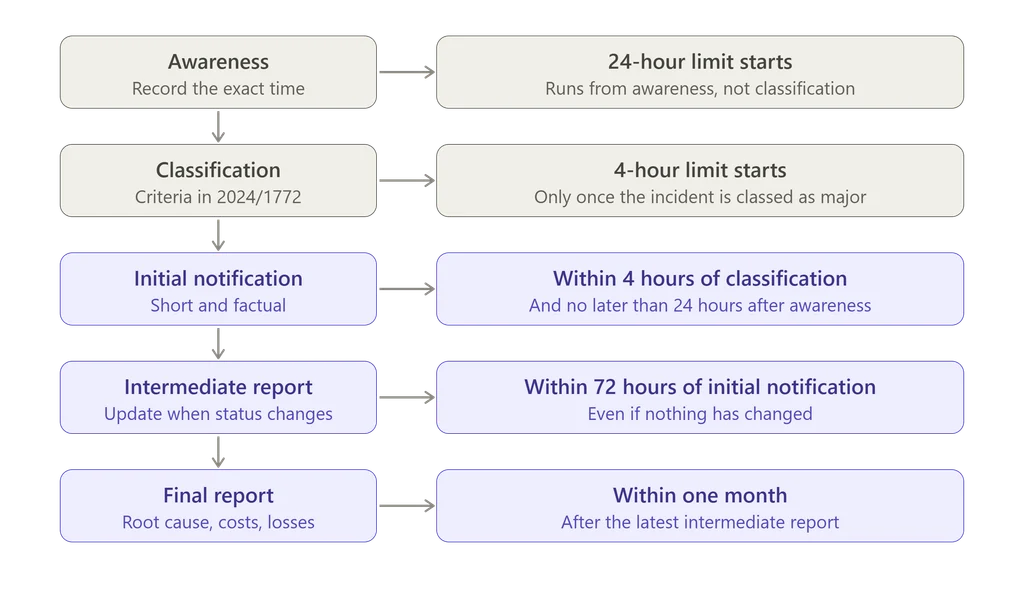
Quick answer: DORA incident reporting requires financial entities to classify each ICT-related incident against the criteria in Delegated Regulation (EU) 2024/1772 and to report major incidents to their competent authority in three steps. The initial notification is due within 4 hours of classification and no later than 24 hours after you become aware. The intermediate report follows within 72 hours of the initial notification. The final report is due within one month of the latest intermediate report.
Does Your DORA Incident Reporting Process Meet the Required Deadlines?
AnnexOps DORA compliance software helps teams track incident classification, reporting timelines and supporting evidence. Check your DORA regime and incident reporting clocks in minutes.No login required.
DORA incident reporting sits in Chapter III of Regulation (EU) 2022/2554 and has applied since January 17, 2025. This guide is part of our overview of DORA compliance software for financial entities. It explains DORA incident reporting from end to end: how to classify an incident, which deadlines apply, what each report must contain, and how to document the process so it holds up under supervision.
| Key fact | Answer |
| Legal basis | Articles 17 to 19 of Regulation (EU) 2022/2554 (DORA) |
| Applies since | January 17, 2025 |
| Who reports | Financial entities in scope of DORA, to their competent authority |
| What is reported | Major ICT-related incidents, plus optional significant cyber threats |
| Classification rules | Delegated Regulation (EU) 2024/1772 |
| Content and deadlines | Delegated Regulation (EU) 2025/301 |
| Forms and templates | Implementing Regulation (EU) 2025/302 |
| Report types | Initial notification, intermediate report, final report, reclassification notice |
What Is DORA Incident Reporting?
DORA incident reporting is the obligation to manage, classify, and report ICT-related incidents under Chapter III of DORA. Article 17 requires an incident management process. Article 18 requires classification. Article 19 requires financial entities to report major ICT-related incidents to the competent authority, and allows them to notify significant cyber threats on a voluntary basis.
An ICT-related incident is a single event or a series of linked events that compromises the security of network and information systems and has an adverse impact on the availability, authenticity, integrity or confidentiality of data, or on the services provided. Only major incidents trigger mandatory DORA major incident reporting.
How Does DORA Classify a Major ICT-Related Incident?
An incident is major when it adversely affects critical services and meets one of two conditions. This is the DORA incident classification test in Delegated Regulation (EU) 2024/1772.
Step 1: Does it affect critical services? Check whether the incident affects ICT services or systems that support critical or important functions, affects financial services that need authorisation or supervision, or involves successful, malicious and unauthorised access to your network and information systems.
Step 2: Does it meet one of two conditions?
- A successful, malicious and unauthorised access to network and information systems that may result in data losses; or
- Two or more materiality thresholds are reached across the criteria below.
| Classification criterion | What it measures |
| Clients, financial counterparts and transactions | How many clients, counterparts or transactions are affected |
| Reputational impact | Whether the incident is visible to the public, media or regulators |
| Duration and service downtime | How long the incident lasts and how long services are down |
| Geographical spread | Whether more than one Member State is affected |
| Data losses | Impact on availability, authenticity, integrity or confidentiality of data |
| Economic impact | Gross direct and indirect costs and losses |
Recurring incidents can also count. If incidents with the same root cause occur at least twice within six months, they can be assessed together as a major incident. If you later find that a reported incident was not major, you submit a reclassification notice.
What Are the DORA Incident Reporting Deadlines?
The DORA incident reporting timeline has three mandatory reports. Delegated Regulation (EU) 2025/301 sets the limits.
| Report | Deadline |
| Initial notification | As early as possible, within 4 hours of classifying the incident as major and no later than 24 hours after you become aware of it |
| Intermediate report | Within 72 hours of the initial notification, even if nothing has changed |
| Updated intermediate report | Without delay when the status changes, and as soon as regular business operations are resumed |
| Final report | No later than one month after the latest intermediate report |
Both limits in the initial notification apply, so the earlier one binds. The 24-hour limit runs from the moment you become aware of the incident, not from classification. That is why classification has to be fast and rehearsed.
Where a deadline falls on a weekend or public holiday, some entities may extend it to noon on the next working day. Credit institutions, central counterparties, trading venues and entities identified as essential or important under NIS2 cannot use this extension for initial and intermediate reports. If you cannot meet a deadline, inform your competent authority without undue delay.
What Must a DORA Incident Report Include?
Each report builds on the one before it. The initial notification is deliberately short. Later reports add detail.
| Report | Main content |
| All reports | Type of submission, entity name and LEI, type of financial entity, who submits |
| Initial notification | Description of the incident, the classification criteria met and how they were fulfilled |
| Intermediate report | More detailed information on the incident, its impact and the measures taken |
| Final report | Root cause classification and explanation, resolution summary, dates and times when the root cause was addressed and the incident resolved, costs and losses |
The templates and data fields come from Implementing Regulation (EU) 2025/302, and the ESAs’ operational instructions explain how to complete them in practice. Those instructions also stress that some identifying fields must stay the same from the initial notification through to the final report. Your competent authority gives each incident a reference code.
How Do You Handle DORA Incident Reporting Step by Step?
- Detect and log. Record the time you became aware of the incident. This starts the 24-hour limit.
- Triage and classify. Apply the Delegated Regulation (EU) 2024/1772 criteria, record the result and the reasoning, and name who decided.
- Notify within 4 hours of classification. Submit the initial notification to your competent authority, no later than 24 hours after awareness.
- Contain and communicate. If clients’ financial interests are affected, inform them without undue delay about the incident and the measures taken (Article 19(3)).
- Report at 72 hours. Submit the intermediate report, and update it without delay as the situation changes.
- Close with the final report. Submit it within one month of the latest intermediate report, with root cause, resolution, and costs.
- Keep the evidence. Retain timestamps, the classification record, the reports and confirmations of receipt.
Where Do DORA Incident Reports Go, and What About NIS2 and PSD2?
You report to your competent authority through the channel it specifies. Authorities forward reports to the relevant ESA and, where applicable, to the ECB and to the authority for NIS2. DORA is the sector-specific regime for financial entities, so one DORA report serves these routes. For payment service providers in scope of DORA, DORA reporting replaces the earlier PSD2 incident reporting.
The Digital Omnibus proposal of November 19, 2025 would introduce a single entry point for incident reporting across several laws. It is still in negotiation, with the Council’s mandate agreed on October 21, 2026, and it does not change today’s DORA incident reporting.
How Should You Document Incident Reporting for Supervisors?
Good DORA incident reporting documentation is what turns a reported incident into evidence. Keep:
- the incident register, with timestamps for awareness, classification, and each report
- the classification record, with the criteria considered and the decision
- the submitted reports and the authority’s confirmations
- the communications plan and client communications (Article 14)
- the root cause analysis and the lessons learned
- the named owner for each step, and the sign-off
Build this into a routine, and test it. Rehearse DORA incident reporting in exercises so that the 4-hour and 24-hour clocks are not tested for the first time in a real incident.
What Should You Look for in DORA Incident Reporting Software?
DORA incident reporting software should track the clocks and the record, not replace your judgment. Look for:
- Clock tracking. The 4-hour, 24-hour, 72-hour, and one-month clocks visible from the moment you record awareness and classification.
- Classification support. The Delegated Regulation (EU) 2024/1772 criteria, recorded with reasoning, and recurring incident tracking.
- Report preparation. Fields aligned with the ITS templates, so data is ready to submit through your authority’s channel.
- Evidence. Tamper-evident records for timestamps and decisions.
- Human sign-off. A named person approves each classification and report.
- Reuse. Links to your register of information, ICT, risk, and testing records.
Be careful with tools that promise to classify incidents automatically or to file reports for you. Classification and submission remain your entity’s responsibility.
How the AnnexOps AI Governance Platform Supports DORA Incident Reporting
The AnnexOps AI Governance Platform treats DORA compliance software as evidence on the record.
- Incident clock engine: stages the DORA incident reporting clocks (Article 19) as modelled from RTS 2025/301 once you record the classification.
- Regime derivation: versioned rules derive whether the full framework or the simplified Article 16 framework applies to you. No language model sits in the verdict path.
- Continuous evidence: read-only connectors collect configuration metadata, and records are append-only and hash-chained.
- Audit Room: read-only, time-boxed access for your internal auditor.
AnnexOps does not file your incident reports and does not classify incidents for you. You submit through your competent authority’s channel, and coverage percentages are indicative.
Ready to Improve Your DORA Incident Reporting Process?
AnnexOps DORA compliance software connects incident classification, reporting timelines and tamper-evident evidence. Track key deadlines and link incident records with your ICT risk and Register of Information data.Book a 30-minute expert call to identify gaps in your DORA incident reporting workflow.
Related Reading
- DORA Compliance Software for Financial Entities
- DORA compliance automation
- NIS2 compliance automation
- ISO 27001 compliance automation
- DORA Register of Information: What Financial Entities Need to Track
- DORA Digital Operational Resilience Testing: Requirements and Evidence
Author: Nitin Grover
Nitin Grover is an AI compliance strategist and writer focused on EU AI Act compliance, AI governance, Annex IV documentation, AI risk management, and AI compliance operations for AI startups, SaaS companies, and enterprise AI teams across Europe.