
In this article
- What Is the DORA Register of Information?
- What Entities Does DORA Apply To?
- What Must the DORA Register of Information Contain?
- What Is the DORA Register of Information Template, and Can You Use Excel?
- Which ICT Arrangements Belong in the DORA Register of Information?
- How Do You Decide Which Functions Are Critical or Important?
- How Do You Handle Subcontractors in the DORA Register of Information?
- When Is the DORA Register of Information Due in 2026?
- What Should a Financial Entity Do Regarding ICT Service Providers Under DORA?
- What Must DORA Reports Include?
- Five Mistakes That Cause Supervisory Questions
- How to Build and Maintain the DORA Register of Information
- What Should You Look for in DORA Register of Information Software?
- How the AnnexOps AI Governance Platform Helps With the DORA Register of Information
- Ready to Improve Your DORA Register of Information?
- Related Reading
- Author: Nitin Grover
Quick answer: The DORA register of information is the structured record of all contractual arrangements for third-party ICT services that Article 28(3) of Regulation (EU) 2022/2554 requires financial entities to maintain. It follows the templates in Implementing Regulation (EU) 2024/2956, reports at least yearly to your competent authority in the prescribed format (XBRL-CSV), and shows which arrangements support critical or important functions.
Is your DORA register of information still a spreadsheet nobody trusts?
AnnexOps AI Governance Platform builds your DORA register of information on the supplier register you already keep and exports it to CSV, so you are not rebuilding it every reporting cycle.
The DORA register of information is the data layer of DORA third-party risk management, and it is only as good as the records behind it. This guide is part of our overview of DORA compliance software for financial entities. It explains what the register must contain, which arrangements belong in it, when it is due in 2026, and how engineering and compliance teams can keep it accurate without a spreadsheet maze.
| Key fact | Answer |
| Legal basis | Article 28(3) of Regulation (EU) 2022/2554 (DORA) |
| Templates | Commission Implementing Regulation (EU) 2024/2956 |
| Levels | Entity, sub-consolidated and consolidated |
| Format | xBRL-CSV, using the ESAs’ technical package, or the format your authority prescribes |
| Reporting | At least yearly to the competent authority, and on request |
| 2026 cycle | Reference date December 31, 2025, with national submission windows in March 2026 |
| Next cycle | Reference date December 31, 2026, with a date set by your authority |
What Is the DORA Register of Information?
The DORA register of information is a register of all contractual arrangements for the use of ICT services provided by ICT third-party service providers. Article 28(3) requires financial entities to maintain and update it at the entity level and at the sub-consolidated and consolidated levels. Four points define the duty:
- It covers all arrangements, not only the critical ones. The register must distinguish ICT services that support critical or important functions from the rest.
- It is reported. Entities report to their competent authority at least yearly on the number of new arrangements, the categories of providers, the type of arrangements and the ICT services and functions provided.
- It is available on request. The full register must be given to the authority, with any information it asks for.
- Changes must be flagged. You must inform the authority in good time of any planned arrangement that supports a critical or important function, and when a function becomes critical or important.
The register also has a supervisory use beyond your own entity. The European Supervisory Authorities used registers collected from financial entities as data for designating critical ICT third-party providers, and published the first list on November 18, 2025.
What Entities Does DORA Apply To?
DORA applies to 20 types of financial entities listed in Article 2, and to the ICT third-party service providers they rely on. The list includes credit institutions, payment and e-money institutions, investment firms, crypto-asset service providers, insurance and reinsurance undertakings and intermediaries, pension funds, trading venues, central counterparties and depositories, fund managers, credit rating agencies and crowdfunding providers. Each in-scope entity keeps a DORA register of information, with a simplified framework under Article 16 for the entities it lists. Group structures can share one register that covers the entity, sub-consolidated and consolidated levels.
What Must the DORA Register of Information Contain?
Implementing Regulation (EU) 2024/2956 sets the standard templates in its Annex I. There are 15 interlinked templates, so one provider or service can appear in several of them. The main content areas are:
| Content area | What to record | Template reference |
| The financial entity | Who maintains the register, and for which entity and group level | B_01.01 |
| Contractual arrangements | Each arrangement, with a unique contractual arrangement reference number | Annex I, contractual arrangement templates |
| Direct providers and subcontractors | Providers identified by LEI or EUID, and the subcontractors that matter | B_05.01 |
| The ICT service supply chain | How each provider links to its sub-providers | B_05.02 |
| Functions supported | Which of your functions use each service, with critical or important functions flagged | Annex I, function templates |
| Assessments of services | For services supporting critical or important functions, such as the level of reliance | Annex I, assessment templates |
Each financial entity needs a Legal Entity Identifier (LEI). ICT third-party providers are identified by LEI or, for providers established in the EU, an EUID. Providers established in third countries are identified by LEI only.
What Is the DORA Register of Information Template, and Can You Use Excel?
The DORA register of information template is the set of 15 interlinked templates in Annex I of Implementing Regulation (EU) 2024/2956. You can use Excel to collect and maintain the data internally, but the file you submit is not a free-form spreadsheet. The ESAs specified xBRL-CSV, a package of CSV files that follows the EBA taxonomy and passes technical validation rules. The ESAs did not provide a conversion tool for official reporting.
Authorities handle the submission differently:
| Authority | Submission format |
| BaFin (Germany) | A structured xBRL file, or BaFin’s own Excel template, which it converts |
| AFM (Netherlands) | xBRL-CSV only from 2026. Excel conversion was a one-time service in 2025 |
| FMA (Liechtenstein) | xBRL-CSV only, no Excel |
| Central Bank of Ireland | A zipped package of xBRL-CSV files, not a single spreadsheet |
Follow your own authority’s instructions and portal, and do not change the structure of the template files. Before you submit, check that:
- required data fields are complete
- provider identifiers (LEI or EUID) and contractual references are consistent
- business functions are correctly mapped
- supply chain information is complete where required
- the file follows the current technical specifications
- the file passes the validation checks
Which ICT Arrangements Belong in the DORA Register of Information?
All contractual arrangements for ICT services belong in it, not only the obvious ones. DORA defines ICT services as digital and data services provided through ICT systems to internal or external users on an ongoing basis. For a technology-driven entity, that includes:
- cloud hosting, platform and infrastructure services
- software-as-a-service tools used in operations
- data and analytics services
- managed security, monitoring and support services
- intra-group ICT services
- AI services and third-party models integrated in your processes
If you buy AI tools, include them. Our guide to AI vendor risk management and the AI vendor due diligence questionnaire show what to ask these suppliers.
How Do You Decide Which Functions Are Critical or Important?
The DORA register of information asks you to identify the functions your ICT services support and to flag the critical or important ones. Article 3(22) defines a critical or important function as one whose disruption would materially impair your financial performance or the soundness or continuity of your services, or whose discontinued, defective or failed performance would materially impair your continued compliance with your authorisation or your other obligations under financial services law.
You make this assessment using your own analysis. Supervisors expect a risk-based approach, written down, with an owner and a review date. The result drives the depth of the register: for services that support critical or important functions, you record additional information, including assessments and the supply chain.
How Do You Handle Subcontractors in the DORA Register of Information?
DORA does not ask you to list every sub-supplier of every provider. The standards limit the register to subcontractors that effectively underpin ICT services supporting critical or important functions, or material parts of them. Delegated Regulation (EU) 2025/532 covers the subcontracting conditions for those services.
- Ask each provider supporting a critical or important function for its subcontractors on that service.
- Record the chain in the supply chain template, so each provider links to its sub-providers.
- Keep the first external provider in the chain in the direct provider template as well.
- Re-check when a provider changes its own suppliers.
When Is the DORA Register of Information Due in 2026?
There is no single filing date for entities. Your competent authority sets it, and competent authorities must transmit the registers to the ESAs by March 31 each year. For the 2026 cycle:
| Item | 2026 cycle |
| Reference date | December 31, 2025 |
| Competent authority to ESAs | By March 31, 2026 |
| Example: CSSF (Luxembourg) | Filing window: February 11 to March 31, 2026 |
| Example: BaFin (Germany) | Submission window: March 9 to 30, 2026 |
| ESA quality checks | During April 2026, with resubmission where errors are found |
Many submissions were rejected on data quality in the first cycles, so submit early and validate before the deadline. The next cycle uses December 31, 2026, as its reference date. Check your authority’s published window and follow it.
What Should a Financial Entity Do Regarding ICT Service Providers Under DORA?
DORA keeps the financial entity responsible for its own compliance, even when ICT services are outsourced. In practice, that means:
- Adopt an ICT third-party risk strategy and policy, approved by the management body.
- Maintain the DORA register of information for all arrangements.
- Assess providers before contracting, including concentration risk (Articles 28 and 29).
- Include the key contractual provisions required by Article 30.
- Monitor providers over time and review the arrangement on a schedule.
- Plan exits for services that support critical or important functions.
For the full picture, see our guide to DORA compliance software for financial entities.
What Must DORA Reports Include?
DORA reports are mainly incident reports, and each report has its own content under Delegated Regulation (EU) 2025/301. They cover the entity and LEI, a description of the incident, the classification criteria met, and in the final report, the root cause, resolution, and costs. Our guide to DORA incident reporting explains the classification, deadlines, and documentation. The DORA register of information is a separate yearly report.
Five Mistakes That Cause Supervisory Questions
- Spreadsheet silos. Procurement, IT, and legal each hold part of the picture. Pick one system of record.
- Inconsistent provider identity. The same provider appears under different names or without an LEI or EUID.
- No link to functions. The register lists contracts, but not which of your functions depend on them.
- Incomplete supply chains. Subcontractors behind critical services are missing.
- Stale data. The register matches the contracts of last year, and shadow suppliers, including AI tools, never entered it.
How to Build and Maintain the DORA Register of Information
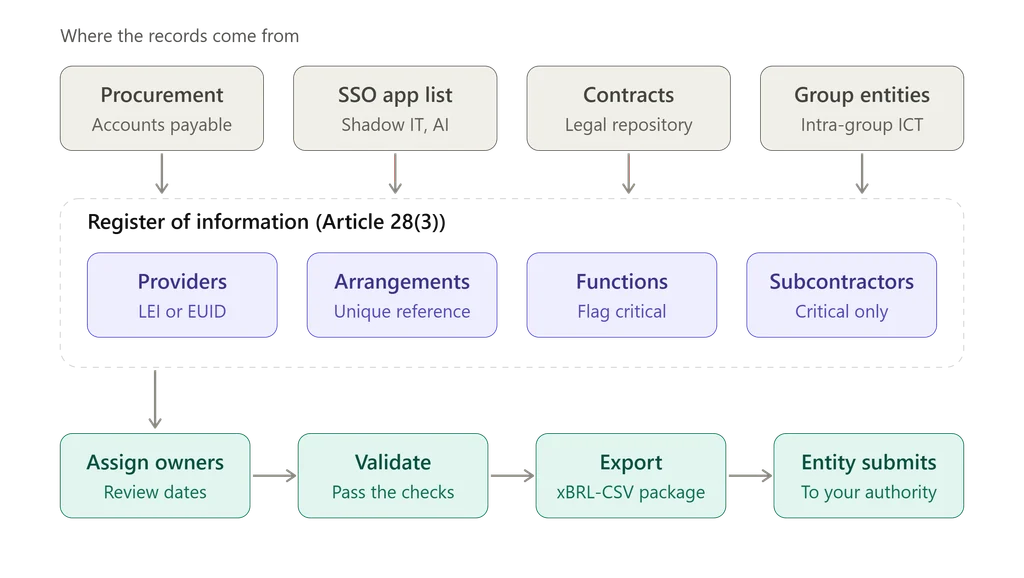
- Source the inventory. Pull suppliers from procurement, accounts payable, your SSO app list, and contract repositories.
- Normalise identities. One record per provider, with LEI or EUID and parent entity.
- Map functions. Link each service to the functions that use it, and flag critical or important ones.
- Assess the critical ones. Record reliance, alternatives, and supply chain.
- Assign owners and review dates. A named person owns each record.
- Export and validate. Generate the file in the required format, run the checks, and keep a dated copy.
If you already keep a supplier register for ISO 27001, build on it rather than starting again. The DORA fields and templates still have to be completed in full.
What Should You Look for in DORA Register of Information Software?
DORA register of information software should help you build and maintain the data, not just fill in a file. Look for:
- ITS-aligned fields and code lists, so the data matches Implementing Regulation (EU) 2024/2956.
- Validation before submission, with clear error messages.
- Provider identity management, with LEI and EUID fields and one record per provider.
- Function mapping, with critical or important functions flagged.
- Supply chain records for subcontractors that matter.
- Ownership, review dates and an audit trail for every change.
- Export in the format your authority requires.
Be careful with tools that claim to file the register for you. The submission to your competent authority is your entity’s responsibility.
How the AnnexOps AI Governance Platform Helps With the DORA Register of Information
The AnnexOps AI Governance Platform treats DORA compliance software as evidence on the record, and the DORA register of information is part of it.
- Register of information: an Article 28(3) register built on your existing supplier register, with a CSV export.
- Regime derivation: versioned rules derive whether the full framework, the simplified Article 16 framework or neither applies to you.
- 46 requirements and 82 shared controls: your third-party controls link to the same controls that carry your ISO 27001 and SOC 2 evidence.
- Continuous evidence: read-only connectors collect configuration metadata, and records are append-only and hash-chained.
- Audit Room: read-only, time-boxed access for your internal auditor.
AnnexOps builds the register and exports it to CSV. You submit it to your competent authority in the format it prescribes. Coverage percentages are indicative and are not a measure of compliance.
Ready to Improve Your DORA Register of Information?
Keep supplier records, ICT arrangements and supporting evidence organised with AnnexOps.Book a 30-minute expert call to identify gaps in your DORA Register of Information.
Related Reading
- DORA Compliance Software for Financial Entities
- DORA ICT Incident Reporting: Classification, Timelines and Documentation
- DORA compliance automation
- ISO 27001 compliance automation
- AI Vendor Due Diligence Questionnaire: What to Ask
- DORA Digital Operational Resilience Testing: Requirements and Evidence
Author: Nitin Grover
Nitin Grover is an AI compliance strategist and writer focused on EU AI Act compliance, AI governance, Annex IV documentation, AI risk management, and AI compliance operations for AI startups, SaaS companies, and enterprise AI teams across Europe.