
In this article
- What Is DORA, and Which Financial Entities Must Comply?
- What Does ICT Mean Under DORA?
- What Are the Five Pillars of DORA?
- 1. ICT Risk Management
- 2. ICT-Related Incident Management and Reporting
- 3. Digital Operational Resilience Testing
- 4. ICT Third-Party Risk Management
- 5. Information Sharing
- DORA ICT Risk Management: What Does the Framework Require?
- DORA Third-Party Risk Management: What Must Financial Entities Do?
- ICT Third-Party Risk Strategy and Policy
- Register of Information
- Due Diligence and Concentration Risk
- Contractual Requirements
- Exit and Transition Strategies
- DORA ICT Incident Reporting: Classification and Reporting Deadlines
- What Are the DORA Incident Reporting Timelines?
- DORA Digital Operational Resilience Testing
- What Is Threat-Led Penetration Testing Under DORA?
- What Should Financial Entities Look for in DORA Compliance Software?
- Regime Identification
- Requirement Tracking and Ownership
- ICT Risk and Asset Records
- Register of Information Support
- Incident Reporting Timeline Tracking
- Resilience Testing Records
- Verifiable Evidence
- Human Review and Approval
- Reuse of Existing Compliance Work
- How the AnnexOps AI Governance Platform Supports DORA Compliance
- Ready to Improve Your DORA Readiness?
- Related Reading
- Author: Nitin Grover
The Digital Operational Resilience Act (DORA), Regulation (EU) 2022/2554, has applied to financial entities since 17 January 2025. It establishes requirements for ICT risk management, incident reporting, digital operational resilience testing and oversight of ICT third-party providers.
For financial entities, the challenge is not simply understanding the regulation. It is coordinating these obligations across risk, IT, compliance, procurement and management teams while maintaining evidence that demonstrates how controls operate.
When supplier records sit in spreadsheets, incident procedures are maintained separately from reporting workflows, and testing evidence is scattered across different systems, demonstrating DORA readiness becomes difficult. A structured approach to DORA compliance software can help bring these activities into a more manageable workflow.
There is no DORA certificate. Financial entities need to meet the obligations applicable to their organisation and demonstrate their implementation to the relevant competent authority.
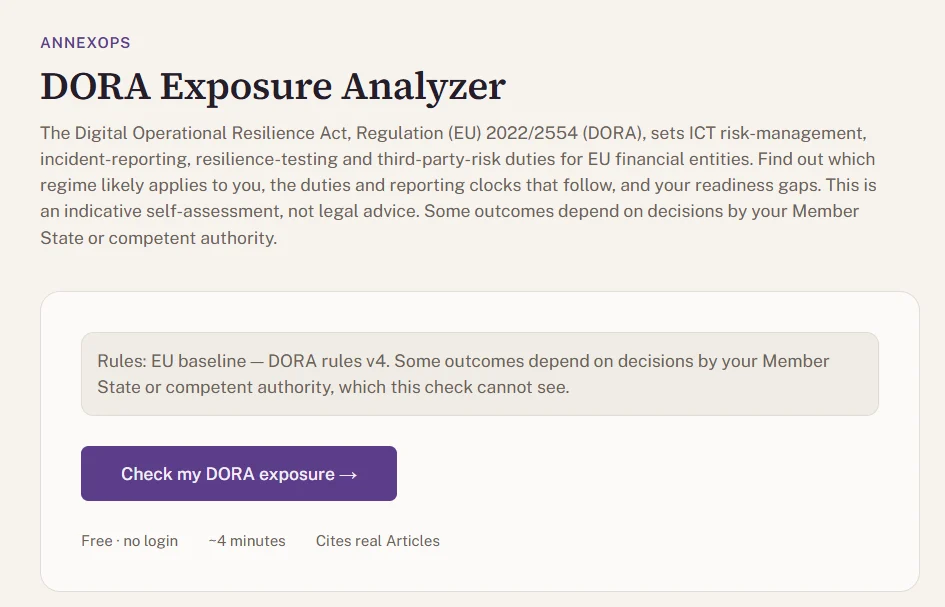
The AnnexOps AI Governance Platform supports this work by helping organisations determine which DORA regime applies, track 46 requirements and organise supporting evidence. This guide explains the main DORA requirements for financial entities, the operational challenges behind them and what to evaluate when selecting DORA compliance software.
For more detailed guidance, explore these related resources:
- DORA Register of Information: What Financial Entities Need to Track
- DORA ICT Incident Reporting: Classification, Timelines and Documentation
- DORA Digital Operational Resilience Testing: Requirements and Evidence
Make DORA Compliance Easier with AnnexOps
Bring ICT risk, third-party oversight and compliance evidence together in one place. Simplify your DORA workflows and strengthen audit readiness.
What Is DORA, and Which Financial Entities Must Comply?
DORA is the EU’s framework for the digital operational resilience of the financial sector. It entered into application on 17 January 2025 and covers 20 types of financial entities, including banks, insurance companies, investment firms and payment institutions. It also establishes an oversight framework for designated critical ICT third-party service providers.
Three features influence how financial entities should approach DORA compliance.
- Proportionality: Article 4 requires organisations to apply the framework in a way that reflects their size, risk profile and the nature, scale and complexity of their services.
- Simplified framework: Article 16 applies to specified categories, including certain small and non-interconnected investment firms, exempted payment and e-money institutions, and small occupational pension funds.
- Layered requirements: The Regulation is supplemented by delegated and implementing acts that provide technical details for specific obligations.
Being DORA compliant means meeting the requirements applicable to your entity and maintaining evidence of implementation. National competent authorities supervise financial entities, while the European Supervisory Authorities (EBA, ESMA and EIOPA) oversee designated critical ICT third-party providers.
For organisations evaluating DORA compliance software, establishing the applicable regime should be an early step. It helps determine which requirements, controls and evidence need to be addressed.
What Does ICT Mean Under DORA?
ICT stands for information and communication technology.
Under DORA, ICT services include digital and data services provided through ICT systems to internal or external users on an ongoing basis. These may include:
- Cloud hosting and infrastructure services.
- Business and financial software.
- Data storage and processing services.
- Managed IT infrastructure.
- Other technology services supporting financial operations.
This broad scope explains why DORA extends beyond an organisation’s internal IT department. Financial entities must also understand the ICT services they obtain from external providers and the risks associated with those arrangements.
A DORA compliance software workflow should therefore connect internal ICT risk management with supplier oversight and supporting documentation.
What Are the Five Pillars of DORA?
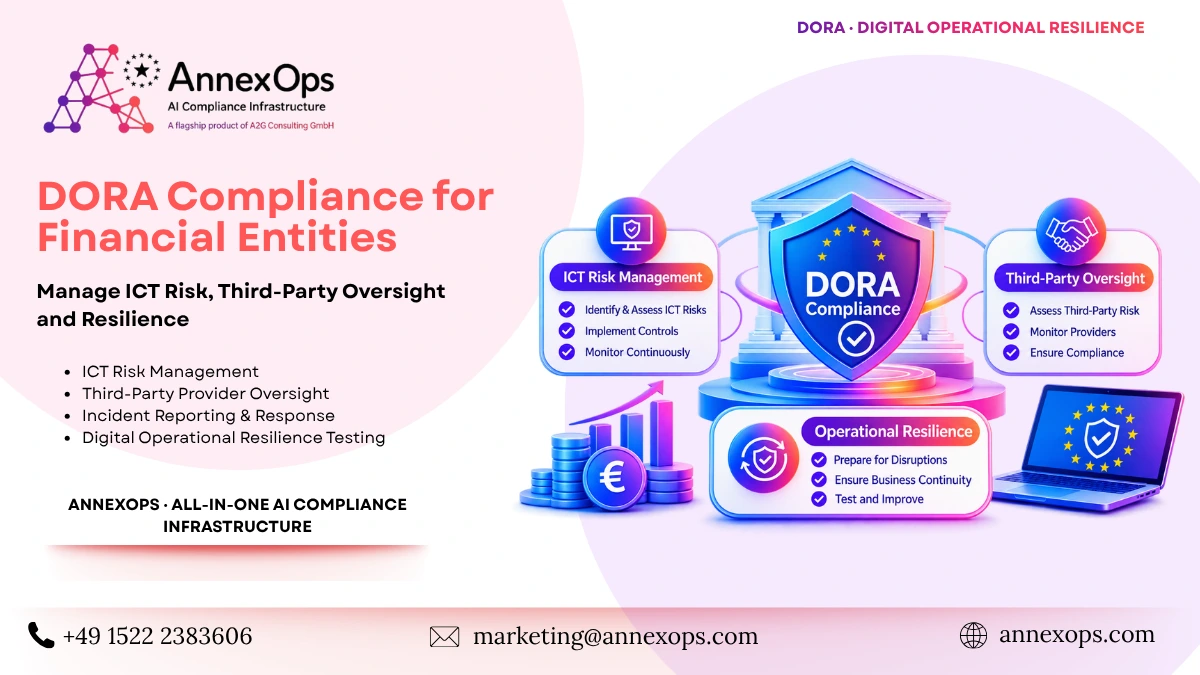
DORA is commonly organised around five areas. Together, they establish the operational requirements financial entities need to address.
1. ICT Risk Management
Chapter II, Articles 5–16, establishes the ICT risk management framework. Delegated Regulation (EU) 2024/1774 provides additional technical requirements.
Financial entities need to identify ICT risks, establish controls, maintain protection and detection capabilities, and prepare response and recovery arrangements.
2. ICT-Related Incident Management and Reporting
Chapter III, Articles 17–23, covers ICT-related incident management and reporting. The supporting rules include Delegated Regulations (EU) 2024/1772 and 2025/301 and Implementing Regulation (EU) 2025/302.
Organisations need processes for identifying, classifying, documenting and reporting major ICT-related incidents.
3. Digital Operational Resilience Testing
Chapter IV, Articles 24–27, addresses resilience testing. Delegated Regulation (EU) 2025/1190 provides additional requirements for threat-led penetration testing.
Financial entities need a proportionate testing programme and records of test results, identified weaknesses and remediation.
4. ICT Third-Party Risk Management
Chapter V, Articles 28–44, addresses risks arising from ICT third-party service providers. Relevant supporting acts include Implementing Regulation (EU) 2024/2956 and Delegated Regulations (EU) 2024/1773 and 2025/532.
This includes supplier assessments, contractual arrangements, the Register of Information and exit strategies.
5. Information Sharing
Chapter VI, Article 45, provides for voluntary arrangements among financial entities to share information and intelligence about cyber threats.
A DORA compliance platform should help organisations maintain visibility across these areas rather than treating each obligation as a disconnected documentation exercise.
DORA ICT Risk Management: What Does the Framework Require?
The management body has an important role in the ICT risk management framework.
Under Article 5, it is responsible for defining, approving, and overseeing the framework. Article 6 requires a documented framework, and entities other than microenterprises must arrange an internal audit review under Article 6(6).
The framework covers several operational activities:
- Identification: Maintain an understanding of ICT assets, systems, dependencies, and risks under Article 8.
- Protection and prevention: Establish safeguards to protect ICT systems and information under Article 9.
- Detection: Develop capabilities to identify anomalous activities and potential ICT incidents under Article 10.
- Response and recovery: Maintain procedures for responding to incidents and restoring services under Article 11.
- Backup and restoration: Establish appropriate backup policies and restoration procedures under Article 12.
Entities covered by Article 16 apply the simplified framework instead.
In practice, financial entities need more than written policies. They need an ICT asset and risk register, clear control ownership, evidence that controls operate over time and records of management body decisions.
This is where DORA compliance software can support the operational process. A centralised workflow makes it easier to connect requirements with responsible teams, supporting records and open remediation activities.
DORA Third-Party Risk Management: What Must Financial Entities Do?
ICT third-party risk management is a major operational responsibility under DORA.
Chapter V establishes that financial entities remain responsible for meeting their regulatory obligations even when they outsource ICT services. Working with a cloud provider, software vendor or managed infrastructure company does not transfer that responsibility.
Financial entities need to address the following areas.
ICT Third-Party Risk Strategy and Policy
Article 28 requires a strategy for ICT third-party risk. Organisations should establish responsibilities, oversight arrangements and policies that reflect their reliance on external ICT services.
Register of Information
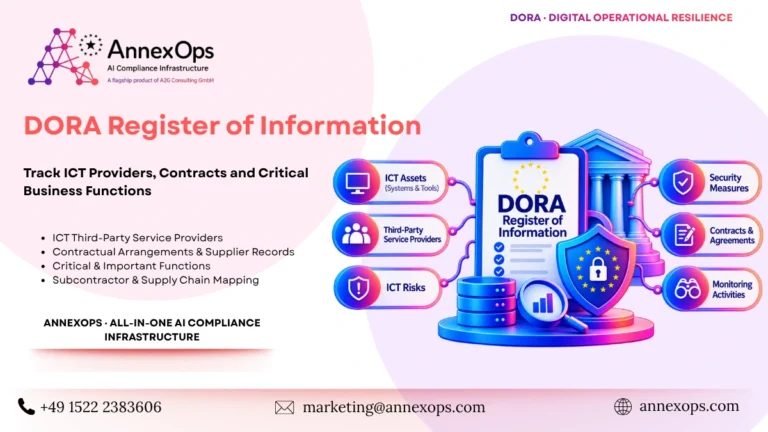
Article 28(3) requires financial entities to maintain a register of information covering contractual arrangements with ICT third-party service providers. The register must identify arrangements supporting critical or important functions and be maintained in accordance with the applicable requirements.
The information needs to be accurate and available for submission to the competent authority as required.
Due Diligence and Concentration Risk
Articles 28 and 29 address pre-contract assessments and concentration risk. Financial entities should evaluate providers before entering into arrangements and understand the potential consequences of relying on a limited number of providers.
Contractual Requirements
Article 30 establishes key contractual provisions for ICT services. Additional contractual requirements apply to arrangements supporting critical or important functions.
Exit and Transition Strategies
Article 28 also requires appropriate exit strategies for ICT services supporting critical or important functions. Organisations should consider how they would transition services without disrupting business operations or compromising resilience.
The European Supervisory Authorities published the first list of 19 designated critical ICT third-party providers on 18 November 2025. Articles 31–44 establish the oversight framework and the powers of the Lead Overseer, including periodic penalty payments of up to 1% of average daily worldwide turnover.
This oversight does not replace a financial entity’s own third-party risk management responsibilities.
For organisations managing multiple ICT providers, DORA compliance software can help connect supplier information, contractual records, risk assessments and ownership in a more consistent process.
DORA ICT Incident Reporting: Classification and Reporting Deadlines
Chapter III requires financial entities to establish an ICT-related incident management process, classify incidents and report major ICT-related incidents to their competent authority.
An incident’s classification depends on factors such as:
- The number of clients and financial counterparties affected.
- The duration of the incident.
- Geographical spread.
- Data losses and the impact on data availability, authenticity, integrity or confidentiality.
- The criticality of affected services.
- The economic impact.
These criteria are set out in Delegated Regulation (EU) 2024/1772. Recurring incidents with the same apparent root cause that occur at least twice within six months can also be relevant to classification.
What Are the DORA Incident Reporting Timelines?
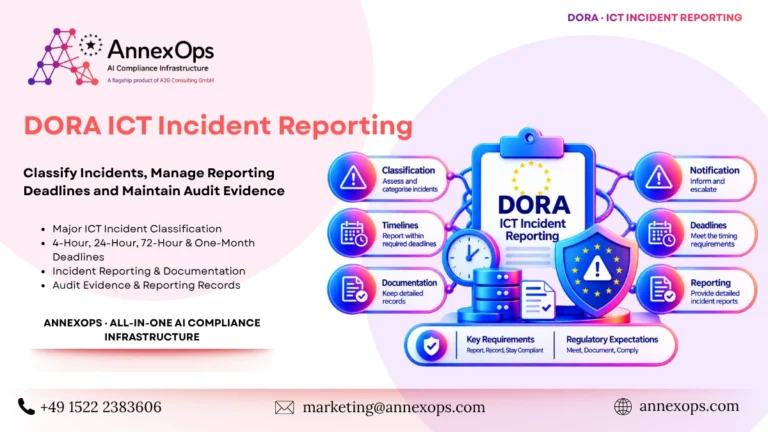
Delegated Regulation (EU) 2025/301 establishes reporting timelines for major ICT-related incidents.
- Initial notification: As early as possible, within four hours of classifying the incident as major and no later than 24 hours after becoming aware of it.
- Intermediate report: Within 72 hours of the initial notification, with further updates as required.
- Final report: Within one month of the latest intermediate report.
If an incident is classified as major only after the 24-hour period, the initial notification is due within four hours of that classification.
Certain entities, including credit institutions, central counterparties, trading venues and entities identified as essential or important under NIS2, cannot use the weekend and holiday extension available to some other entities for initial and intermediate reports.
Implementing Regulation (EU) 2025/302 establishes the relevant templates and forms. Financial entities may also voluntarily notify significant cyber threats.
The Digital Omnibus proposal of 19 November 2025 includes a proposed single incident reporting entry point that also affects DORA. As of November 2026, the proposal remains under negotiation. It does not change the reporting deadlines described above.
For financial entities, the operational challenge is maintaining a clear record of incident discovery, classification, decisions and reporting milestones. DORA compliance software can help make these responsibilities and timelines visible, provided the organisation records the relevant incident information and decisions.
DORA Digital Operational Resilience Testing
Article 24 requires financial entities to establish a digital operational resilience testing programme proportionate to their size, business and risk profile.
The programme must include appropriate tests of ICT systems and applications supporting critical or important functions at least annually.
Article 25 identifies different types of testing, including:
- Vulnerability assessments and scans.
- Scenario-based testing.
- Penetration testing.
- Other appropriate resilience tests.
Organisations must prioritise, classify and remediate weaknesses identified during testing.
What Is Threat-Led Penetration Testing Under DORA?
Threat-led penetration testing (TLPT) is a more specialised requirement.
Under Article 26, financial entities identified by their competent authority must carry out TLPT at least every three years. Testing must be performed by testers meeting the requirements of Article 27.
Where internal testers are used, external testers must be contracted for every third test.
Delegated Regulation (EU) 2025/1190 establishes the identification criteria and testing process. Microenterprises and entities covered by Article 16 are outside this TLPT requirement.
A DORA compliance software workflow can help organise testing programmes, results, remediation records and supporting evidence. It does not replace the actual testing activities or the qualified testers required for TLPT.
What Should Financial Entities Look for in DORA Compliance Software?
Not every DORA compliance platform provides the same capabilities. Some focus mainly on document templates, while others support requirement tracking, ICT risk records, supplier oversight and operational evidence.
Financial entities should evaluate DORA compliance software against their actual regulatory and operational needs.
Regime Identification
The solution should help determine whether the full or simplified framework applies to the financial entity. Incorrect assumptions about scope can affect the entire readiness process.
Requirement Tracking and Ownership
Look for a way to map applicable requirements to responsible teams, controls, open tasks and supporting records.
ICT Risk and Asset Records
DORA risk management software should help organisations maintain visibility over ICT assets, risks, suppliers and relevant dependencies.
Register of Information Support
The platform should support the organisation’s supplier records and help prepare the required Register of Information in the prescribed format.
Incident Reporting Timeline Tracking
Financial entities should be able to track incident classification and reporting milestones, including the applicable four-hour, 24-hour, 72-hour and one-month timelines.
Resilience Testing Records
A useful DORA compliance platform should organise testing programmes, results, remediation activities, and, where applicable, TLPT records.
Verifiable Evidence
Look for traceable records showing what information was collected, when it was recorded, and who was responsible. Evidence should support review rather than rely entirely on screenshots assembled shortly before an audit.
Human Review and Approval
The platform should make it possible to identify the people responsible for decisions and approvals. Technology can organise evidence and workflows, but the financial entity retains responsibility for its obligations.
Reuse of Existing Compliance Work
If your organisation already maintains ISO 27001, SOC 2 or NIS2 evidence, consider whether the DORA compliance software can help reuse relevant information where the underlying requirements overlap.
Be cautious of vendors claiming that their software automatically makes an organisation DORA compliant or submits regulatory reports on its behalf. Financial entities remain responsible for their compliance decisions and submissions to competent authorities.
How the AnnexOps AI Governance Platform Supports DORA Compliance
The AnnexOps AI Governance Platform supports DORA compliance through structured requirement tracking, regime identification, and evidence organisation.
The platform connects regulatory requirements with recorded organisational information and supporting evidence.
Its capabilities include:
- Regime derivation: Versioned rules determine whether the full framework, the simplified Article 16 framework, or an out-of-scope status applies. No language model sits in the verdict path.
- 46 requirements and 82 shared controls: Shared controls connect DORA work with ISO 27001, SOC 2 and NIS2 evidence where relevant.
- Register of Information: The register is built on existing supplier information and supports CSV export.
- Incident clock engine: The platform stages the Article 19 reporting clocks modelled from RTS 2025/301 after the organisation records the incident classification.
- Resilience testing record: Financial entities can organise their Article 24–27 testing programme and track TLPT where their competent authority designates them.
- Continuous evidence: Read-only connectors to GitHub, Amazon Web Services and Microsoft Entra ID collect configuration metadata. The platform runs 743 checks against the frameworks held, with append-only, hash-chained records.
- Audit Room: Read-only, time-limited access supports internal auditor review under Article 6(6).
The platform supports the organisation’s evidence and compliance workflows. AnnexOps does not file the Register of Information or incident reports, conduct TLPT or replace legal counsel. Coverage percentages are indicative and should not be interpreted as a prediction of supervisory or audit outcomes.
As DORA compliance software, AnnexOps helps financial entities organise relevant requirements, supplier information, incident timelines and evidence in one workflow. The financial entity remains responsible for its decisions, implementation and regulatory submissions.
Ready to Improve Your DORA Readiness?
DORA requires financial entities to demonstrate how their ICT risk, third-party oversight, incident management and resilience testing operate.AnnexOps helps organise these activities and their supporting evidence.
Related Reading
- DORA compliance automation
- NIS2 compliance automation
- ISO 27001 compliance automation
- SOC 2 compliance automation
- DORA Register of Information: What Financial Entities Need to Track
- DORA ICT Incident Reporting: Classification, Timelines and Documentation
- DORA Digital Operational Resilience Testing: Requirements and Evidence
Author: Nitin Grover
Nitin Grover is an AI compliance strategist and writer focused on EU AI Act compliance, AI governance, Annex IV documentation, AI risk management, and AI compliance operations for AI startups, SaaS companies, and enterprise AI teams across Europe.

[…] management, and it is only as good as the records behind it. This guide is part of our overview of DORA compliance software for financial entities. It explains what the register must contain, which arrangements belong in […]
[…] (EU) 2022/2554 and has applied since January 17, 2025. This guide is part of our overview of DORA compliance software for financial entities. It explains DORA incident reporting from end to end: how to classify an […]