
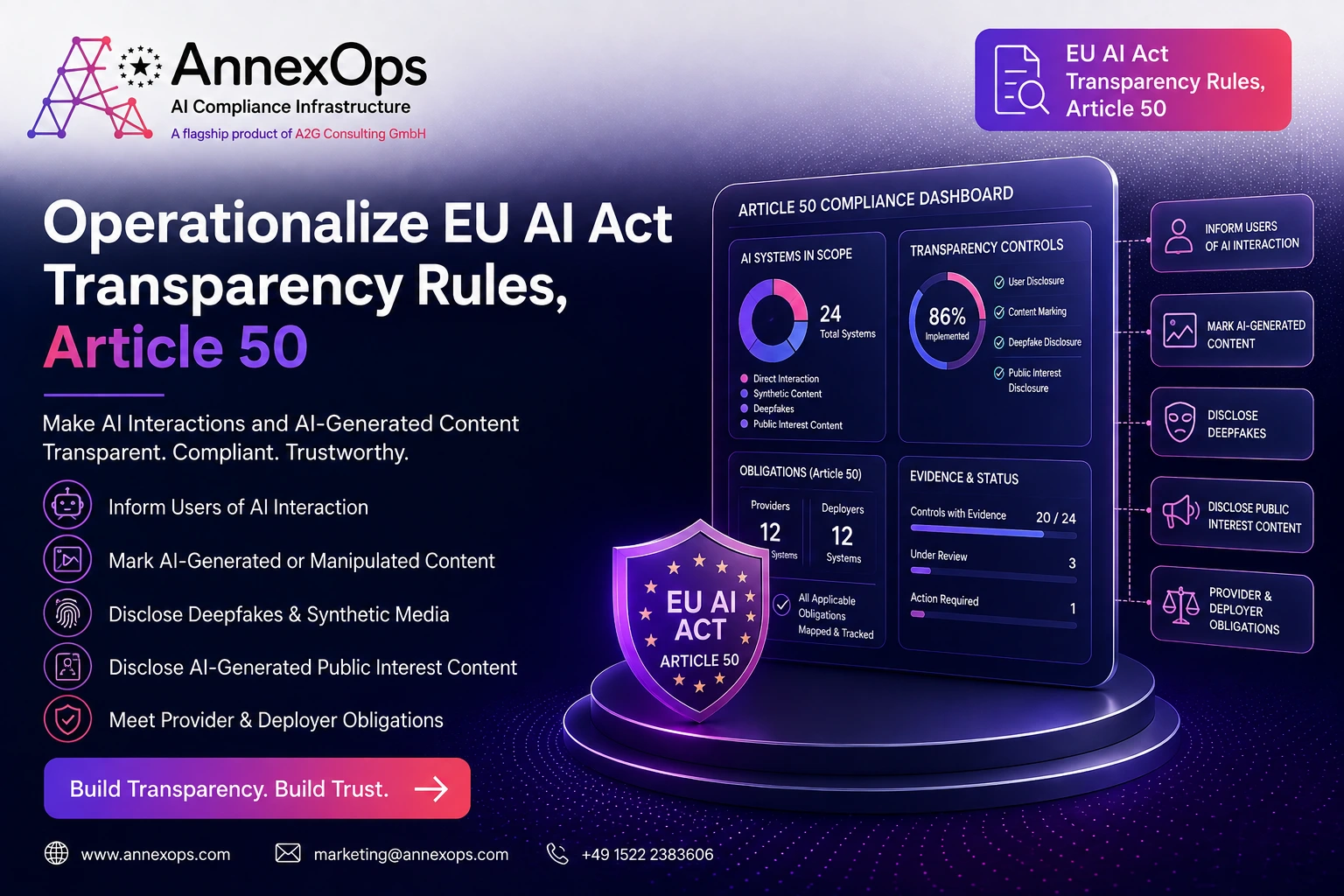
EU AI Act Transparency Rules: What Article 50 Requires
For many AI companies, transparency used to be treated as a product-design principle: tell users when they are interacting with AI, explain limitations, and avoid misleading outputs.
Under the EU AI Act, transparency is becoming something more concrete.
As of 2 August 2026, Article 50 of the EU AI Act applies, introducing specific transparency obligations for providers and deployers of certain AI systems. The European Commission published dedicated Article 50 guidelines in July 2026 to clarify how these obligations apply to interactive AI systems and AI-generated or manipulated content.
For AI companies operating in Europe, this changes the compliance conversation.
The question is no longer simply:
“Is our AI transparent?”
It is:
“Can we demonstrate, document, monitor, and operationalize the transparency controls required for the AI systems we provide or deploy?”
That distinction matters.
Transparency requirements can touch product teams, engineering, compliance, legal, security, data governance, and customer-facing operations. For companies selling AI into the enterprise market, they can also become part of procurement and vendor due diligence.
This is why EU AI Act Transparency Rules should be viewed as an operational governance issue, not just a legal requirement.
What Are the EU AI Act Transparency Rules?
Article 50 establishes transparency obligations for specific categories of AI systems.
The objective is straightforward: people should understand when they are interacting with AI or when they are exposed to AI-generated or manipulated content.
Article 50 covers several situations, including:
- AI systems that directly interact with natural persons
- AI systems generating synthetic audio, image, video, or text
- Emotion recognition and biometric categorisation systems
- AI-generated or manipulated deepfake content
- Certain AI-generated text published to inform the public about matters of public interest
The precise obligations differ depending on whether an organization is acting as a provider or a deployer.
The European Commission’s current guidance emphasizes that the transparency obligations are intended to help people recognize AI interaction and AI-generated content, reducing risks such as deception and manipulation.
Article 50 is not simply a “high-risk AI” rule
This is an important distinction for AI companies.
The EU AI Act uses a risk-based framework, but Article 50 is a separate set of transparency obligations covering certain AI systems based on how they interact with people or generate content.
Therefore, organizations should not assume:
“Our AI isn’t classified as high-risk, so Article 50 doesn’t matter.”
That can be the wrong approach.
At the same time, an AI system can be subject to both Article 50 transparency requirements and additional obligations that apply to high-risk systems.
That means compliance needs to begin with understanding the AI system, its intended purpose, its role in the AI value chain, and the obligations connected to it.
EU AI Act Article 50: What Organizations Need to Understand
The practical impact of EU AI Act Article 50 depends on what the system does and whether the organization is the provider or deployer.
AI systems that directly interact with people
Providers of AI systems intended to interact directly with natural persons must ensure that people are informed that they are interacting with AI, unless this is obvious given the circumstances and context.
This is particularly relevant to:
- AI customer-service agents
- AI assistants
- Conversational interfaces
- AI-powered support tools
- Virtual assistants
- Other systems where users may reasonably believe they are interacting with a person
The information must be provided clearly and distinguishably at the latest when the first interaction or exposure occurs.
For product teams, this means transparency cannot simply exist in a compliance document.
It needs to exist inside the product experience.
AI-generated and manipulated content
Article 50 also addresses AI-generated synthetic content.
Providers of AI systems generating synthetic audio, images, video, or text must ensure outputs are marked in a machine-readable format and detectable as artificially generated or manipulated, subject to the applicable conditions and exceptions.
This creates an important engineering and governance question:
Where is the control implemented, and how can the organization prove that it works?
A policy saying “AI-generated content should be identifiable” is not enough.
Organizations need to understand:
- Which systems generate synthetic content?
- Which outputs are covered?
- How is marking implemented?
- What technical mechanism is used?
- How is the control tested?
- Who owns the control?
- How are changes to the system monitored?
Deepfakes and AI-generated public-interest content
Deployers have additional disclosure obligations in specific circumstances.
For example, deployers using AI systems that generate or manipulate image, audio, or video content constituting a deepfake generally need to disclose that the content has been artificially generated or manipulated.
Article 50 also addresses AI-generated or manipulated text published to inform the public about matters of public interest, subject to specific exceptions, including where the content has undergone human review or editorial control and a natural or legal person holds editorial responsibility.
This is where transparency starts intersecting with human oversight.
Human review is not simply a checkbox. In relevant use cases, organizations need a process that establishes who reviews content, what they review, when review occurs, and who holds responsibility for publication.
Why Article 50 Creates an Operational Challenge
The regulatory text is only one part of the problem.
The bigger challenge for growing AI companies is turning regulatory requirements into repeatable operational processes.
Consider a SaaS company offering an AI customer-support platform.
The product may include:
AI model → customer data → chatbot → generated responses → customer-facing interaction → monitoring → product updates
Now introduce Article 50.
The organization may need to determine:
- Is the user clearly informed that they are interacting with AI?
- Where does that disclosure happen?
- Which model generates the output?
- Is the output synthetic content?
- Does machine-readable marking apply?
- Which team owns the control?
- How is the control tested?
- What happens when the product changes?
- What evidence demonstrates compliance?
None of these questions belongs exclusively to the legal department.
They cross multiple operational functions.
The compliance spreadsheet problem
Many organizations initially manage this through spreadsheets, documents, tickets, and disconnected folders.
That approach can work when an organization has a handful of AI systems.
It becomes much harder when the AI portfolio grows.
A company may have:
|
Governance area |
Typical owner |
Operational challenge |
|
AI inventory |
Compliance / Product |
Keeping systems and versions current |
|
Risk classification |
Legal / Compliance |
Maintaining consistent assessments |
|
Transparency controls |
Product / Engineering |
Proving controls exist in production |
|
AI documentation |
Engineering / Compliance |
Keeping technical records current |
|
Human oversight |
Product / Operations |
Defining accountability |
|
Monitoring |
Engineering / Risk |
Detecting changes and incidents |
|
Audit evidence |
Compliance / Legal |
Finding complete evidence quickly |
This is why AI governance needs to move beyond policy documents.
It needs workflows, ownership, evidence, and continuous tracking.
Article 50 and High-Risk AI: Where the Requirements Can Intersect
For companies developing or deploying high-risk AI systems, transparency is only one part of the compliance picture.
High-risk systems have broader requirements covering areas such as:
- Risk management
- Data and data governance
- Technical documentation
- Record-keeping
- Transparency and information for deployers
- Human oversight
- Accuracy, robustness, and cybersecurity
- Quality management
- Post-market monitoring
For high-risk systems, Article 11 requires technical documentation to be prepared before the system is placed on the market or put into service and kept up to date. The required elements are detailed in Annex IV.
Annex IV covers much more than a basic product description.
It includes information about the system’s intended purpose, architecture, development process, data, testing and validation, human oversight, cybersecurity, risk management, monitoring, changes throughout the lifecycle, and post-market monitoring arrangements.
This creates an important strategic lesson:
Transparency cannot be separated from documentation and governance.
If the organization changes an AI model, modifies its intended use, changes the interface, introduces new data, or alters how users interact with the system, the compliance record may need to evolve as well.
That is why effective AI Documentation should be treated as a living governance asset.
The Business Impact: Transparency Is Becoming Part of Enterprise Trust
There is another reason companies should take Article 50 seriously.
Enterprise customers increasingly want evidence, not promises.
When an enterprise evaluates an AI vendor, its questions may extend beyond:
“Does the model work?”
They may ask:
- What AI systems are involved?
- Where is the AI used?
- What data does it process?
- Is the system classified under the EU AI Act?
- How are users informed about AI interaction?
- How is human oversight implemented?
- What documentation is available?
- How are risks monitored?
- What happens when the system changes?
- Can you provide compliance evidence?
This makes AI compliance part of the commercial lifecycle.
For AI startups and SaaS companies, governance maturity can influence whether an enterprise customer views the product as procurement-ready.
A technically impressive AI product with weak governance can create friction during security, legal, privacy, and compliance reviews.
A product backed by clear governance processes can create confidence.
That is the emerging connection between trustworthy AI and enterprise growth.
From Compliance Documentation to AI Compliance Operations
A mature AI compliance strategy should answer five operational questions:
1. What AI systems do we have?
Maintain a centralized AI inventory.
The inventory should provide visibility into systems, owners, intended purposes, versions, use cases, risk classifications, and relevant regulatory obligations.
2. Which obligations apply?
Not every AI system has identical obligations.
Organizations need a structured way to map regulatory requirements to individual systems.
For Article 50, this means identifying whether an AI system falls within relevant transparency scenarios.
For high-risk systems, it may also mean mapping requirements across risk management, documentation, human oversight, monitoring, and other controls.
3. What controls are implemented?
Policies are not controlled.
Organizations need to identify the actual mechanisms used to satisfy requirements.
For example:
Requirement → Control → Owner → Evidence → Review date
This turns regulatory language into an operational workflow.
4. Can we prove compliance?
Audit readiness means evidence should be available before an auditor or customer asks for it.
For high-risk AI, technical documentation must be maintained and made available to relevant authorities as required. The AI Act also includes specific documentation-retention requirements.
The objective should therefore be continuous evidence collection rather than last-minute document preparation.
5. What happens when the AI changes?
AI systems evolve.
Models are updated. Prompts change. Data sources change. Features are added. Vendors change. Interfaces are redesigned.
Governance must therefore follow the AI lifecycle.
For high-risk systems, the AI Act specifically addresses changes, monitoring, and post-market activities, reinforcing the need for lifecycle-based governance rather than a one-time compliance exercise.
Practical Best Practices for EU AI Act Transparency Compliance
Organizations preparing for Article 50 can start with the following operational approach.
Build an AI transparency inventory
Identify every AI system that:
- Interacts directly with users
- Generates or manipulates content
- Produces synthetic media
- Uses emotion recognition
- Uses biometric categorisation
- Publishes AI-generated content in relevant public-interest contexts
Do not rely solely on the legal or compliance team to identify these systems.
Product, engineering, security, procurement, and business teams may know about AI use cases that are not yet recorded centrally.
Assign clear ownership
Every transparency control should have an owner.
For example:
Control: User disclosure
Owner: Product
Technical implementation: Engineering
Governance oversight: Compliance
Evidence: AI documentation repository
This makes accountability clear.
Connect transparency to AI risk management
Transparency should not operate as an isolated checklist.
Connect it to:
- AI risk assessments
- Intended purpose
- Data governance
- Human oversight
- Technical documentation
- Incident management
- Monitoring
- Change management
This produces a much stronger governance model.
Maintain living AI documentation
Documentation should evolve with the AI system.
For high-risk systems, Annex IV documentation must be kept up to date.
Organizations should therefore establish workflows that trigger documentation reviews when significant changes occur.
Build audit readiness continuously
An EU AI Act audit should not be the moment when an organization starts searching for evidence.
Instead, maintain an evidence trail throughout the lifecycle:
Requirement → Assessment → Control → Evidence → Review → Update
This is the foundation of scalable AI compliance operations.
A Note on Article 50 Timing
Article 50 applies from 2 August 2026.
There is a limited transitional provision for certain AI systems already placed on the market before that date, specifically concerning the marking and detection obligation under Article 50(2), with compliance required from 2 December 2026 for those systems. This should not be interpreted as a general grace period for all Article 50 obligations.
For companies building or deploying AI now, the practical takeaway is simple:
Do not wait for the deadline to begin mapping your systems and controls.
The European Commission has already published implementation guidance, giving organizations a clearer basis for operationalizing Article 50.
How AnnexOps Helps Operationalize EU AI Act Compliance
Understanding the EU AI Act is one thing.
Running compliance across a growing AI portfolio is another.
AnnexOps helps organizations operationalize AI governance through structured workflows, centralized documentation, governance tracking, AI risk management, and audit-readiness processes.
Instead of treating compliance as a collection of disconnected documents, organizations can build a more structured governance layer around their AI systems.
AnnexOps can support areas such as:
- AI system inventory — Maintain visibility across the AI portfolio.
- Risk classification — Structure AI risk assessments and identify applicable obligations.
- AI Documentation — Centralize and manage documentation throughout the AI lifecycle.
- Annex IV documentation management — Organize documentation requirements for applicable high-risk AI systems.
- Governance workflows — Connect assessments, controls, owners, reviews, and evidence.
- Continuous monitoring — Track governance activities and changes rather than relying on one-time assessments.
- Audit readiness — Keep compliance evidence structured and accessible.
- AI compliance operations — Turn regulatory requirements into repeatable operational processes.
The value is not simply having another compliance dashboard.
The strategic value is creating an operational connection between:
AI systems → risks → obligations → controls → documentation → evidence → ongoing governance
That connection becomes increasingly important as organizations move from experimenting with AI to operating AI at scale.
The Strategic Shift: From “Compliant AI” to Governed AI
The biggest mistake organizations can make is treating Article 50 as another regulatory checklist.
The broader opportunity is to use transparency requirements as a catalyst for stronger AI governance.
A mature organization should be able to answer:
What AI do we operate?
What risks does it create?
Which regulations apply?
What controls are in place?
Who owns those controls?
What evidence proves they work?
What changes when the AI system evolves?
That is what operational AI governance looks like.
And it is increasingly becoming a business capability, not merely a compliance function.
For AI startups, it can strengthen enterprise procurement readiness.
For SaaS companies, it can reduce compliance friction as products scale into Europe.
For enterprise AI teams, it can create greater visibility across increasingly complex AI portfolios.
And for compliance and legal operations teams, it can replace fragmented compliance activities with structured, repeatable workflows.
Conclusion: Transparency Is Only the Beginning
The EU AI Act Transparency Rules are designed to make AI interactions and AI-generated content more understandable and identifiable.
But the real challenge for organizations is operational.
Article 50 requires organizations to know which AI systems are covered, understand whether they are acting as providers or deployers, implement the appropriate controls, assign ownership, maintain evidence, and keep governance aligned as systems evolve.
For high-risk AI, the challenge becomes even broader, extending into risk management, human oversight, technical documentation, Annex IV, monitoring, and lifecycle governance.
The companies that approach this as a last-minute compliance exercise will likely find themselves managing spreadsheets, fragmented evidence, and repeated manual reviews.
The companies that build AI compliance operations into their product and governance lifecycle can turn regulation into a foundation for trust.
Transparency is not just about telling people that AI is involved.
It is about building an organization capable of proving that its AI is understood, governed, documented, monitored, and accountable.
Ready to operationalize your EU AI Act compliance?
Learn how AnnexOps helps AI-driven companies prepare for the EU AI Act with clarity and confidence.
👉 Book a consultation with AnnexOps
Phone: +49 1522 2383606
Email: marketing@annexops.com
Website: https://annexops.com/
Frequently Asked Questions
1. What are the EU AI Act Transparency Rules?
The EU AI Act Transparency Rules are primarily set out in Article 50 and apply to certain AI systems and use cases. They include obligations related to informing people when they interact with AI, marking certain AI-generated content, and disclosing certain deepfakes and AI-generated public-interest content.
2. When does EU AI Act Article 50 apply?
Article 50 applies from 2 August 2026. A limited transition until 2 December 2026 applies to certain AI systems already placed on the market before 2 August 2026 regarding the marking and detection obligation under Article 50(2).
3. Does Article 50 only apply to high-risk AI systems?
No. Article 50 contains transparency obligations for certain AI systems based on their interaction with people and generation or manipulation of content. These obligations are separate from the broader requirements that apply specifically to high-risk AI systems.
4. What is Annex IV documentation under the EU AI Act?
Annex IV specifies information that must be included in the technical documentation for applicable high-risk AI systems. It covers areas such as the system’s intended purpose, development process, architecture, data, testing, human oversight, risk management, cybersecurity, monitoring, changes, and post-market monitoring.
5. How does Article 50 relate to AI governance?
Article 50 should be incorporated into broader AI governance rather than managed as an isolated requirement. Organizations need to connect transparency controls with AI inventory, risk classification, ownership, documentation, testing, monitoring, and evidence management.
6. Why is AI documentation important for EU AI Act compliance?
AI documentation creates the evidence needed to understand how an AI system was developed, assessed, controlled, and monitored. For applicable high-risk systems, the AI Act requires technical documentation to be prepared before market placement or use and kept up to date.
7. Can AI compliance software help with Article 50?
AI Compliance Software can help organizations operationalize compliance by centralizing AI inventories, assessments, documentation, workflows, ownership, monitoring, and evidence. The software does not replace legal or regulatory judgment, but it can reduce fragmented manual processes and improve governance visibility.
8. How can AnnexOps help with EU AI Act compliance?
AnnexOps helps organizations build operational AI governance through structured workflows, centralized documentation, AI risk management, Annex IV documentation management, monitoring, and audit-ready evidence. This enables teams to manage compliance as an ongoing operational process rather than a one-time documentation exercise.
Author: Nitin Grover
Nitin Grover is an AI compliance strategist and writer focused on EU AI Act compliance, AI governance, Annex IV documentation, AI risk management, and AI compliance operations for AI startups, SaaS companies, and enterprise AI teams across Europe.