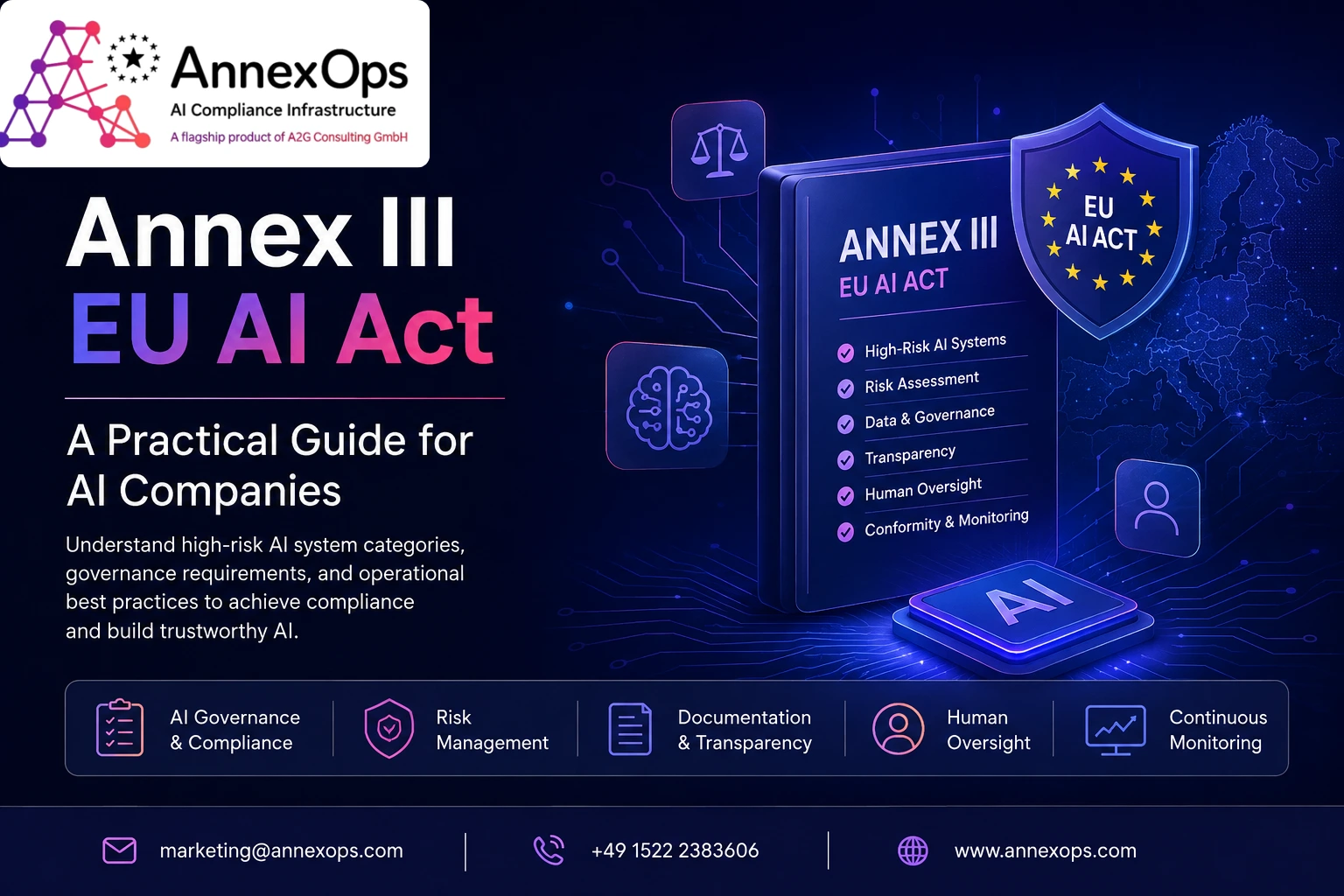
Annex III EU AI Act: A Practical Guide for AI Companies
Artificial intelligence is no longer an experimental technology reserved for innovation labs. It now powers decisions that influence who gets hired, who receives medical treatment, who qualifies for a loan, and even how public services are delivered. As AI becomes more deeply embedded in business operations, regulators are placing greater emphasis on accountability, transparency, and responsible governance.
The EU AI Act represents one of the most significant regulatory developments in the AI industry. While much of the conversation focuses on compliance deadlines and regulatory obligations, one section deserves particular attention from AI startups, SaaS companies, enterprise vendors, and product teams: Annex III of the EU AI Act.
Annex III identifies the categories of high-risk AI systems that require stronger governance, ongoing risk management, detailed technical documentation, and continuous oversight. For organizations developing or deploying AI within these categories, compliance is not simply about preparing documents before an audit. It requires operational processes that support responsible AI throughout the entire lifecycle.
This shift is changing how businesses approach AI development. Instead of treating compliance as a legal exercise completed before product release, organizations are beginning to build AI governance directly into product development, engineering workflows, and operational decision-making.
Companies that establish these governance capabilities early are likely to move faster during enterprise procurement, demonstrate greater customer trust, and respond more efficiently to future regulatory changes.
In this guide, we’ll explore what Annex III EU AI Act means for modern AI companies, why operational readiness matters more than paperwork, and how scalable AI compliance operations can help organizations prepare for long-term regulatory success.
Why Annex III Matters More Than Many Organizations Realize
The EU AI Act introduces a risk-based regulatory framework, meaning not every AI application faces the same level of oversight.
Instead, AI systems are classified according to the level of potential risk they may create for individuals, organizations, or society.
At the center of this framework sits Annex III, which defines the categories of AI systems considered high-risk.
Organizations often assume that only large technology companies fall into these categories. In reality, many startups, SaaS platforms, enterprise software vendors, and AI solution providers may develop applications that support or directly influence regulated activities.
Examples include AI systems used for:
- Recruitment and employment decisions
- Education and examination systems
- Healthcare and medical technologies
- Financial services and credit assessments
- Critical infrastructure
- Law enforcement support
- Public administration
- Border management
- Essential public services
If an AI system performs functions within one of these regulated domains, organizations may have additional compliance obligations under the EU AI Act.
The challenge is that identifying a high-risk AI system is only the beginning.
Once classified, organizations must demonstrate that appropriate governance processes exist to support the AI system throughout its lifecycle, not only during development, but also during deployment, monitoring, updates, and ongoing operation.
This is where many organizations discover that compliance is less about creating documents and more about building repeatable operational processes.
The Growing Compliance Gap Facing AI Companies
Many AI companies have invested heavily in model performance, infrastructure, and product innovation.
Far fewer have invested in the operational capabilities needed to demonstrate regulatory compliance.
This creates what many organizations are beginning to recognize as an AI governance gap.
Engineering teams often maintain technical documentation.
Legal teams manage regulatory interpretation.
Compliance teams oversee policies.
Product managers track releases.
Security teams monitor infrastructure.
Unfortunately, these activities frequently exist in separate systems with limited coordination.
When customers request evidence of governance or when organizations begin preparing for an EU AI Act audit, important information is often scattered across documents, spreadsheets, project management tools, ticketing systems, and internal repositories. As organizations scale, this fragmented approach introduces significant operational risks.
Common operational challenges include:
- Difficulty identifying which AI systems qualify as high-risk
- Inconsistent AI documentation across products and business units
- Limited visibility into AI risk management activities
- Manual governance workflows that are difficult to maintain
- Missing evidence required for regulatory reviews
- Lack of centralized ownership for compliance activities
- Difficulty demonstrating transparency requirements and human oversight
These challenges are rarely caused by a lack of technical capability.
Instead, they result from governance processes that have not evolved alongside increasingly sophisticated AI systems.
For organizations preparing for the EU AI Act, solving these operational issues is becoming just as important as building accurate and reliable AI models.
From Documentation to Operational Readiness
One of the biggest misconceptions surrounding the EU AI Act is that compliance is primarily a documentation exercise.
While documentation remains essential, particularly for Annex IV documentation, regulators and enterprise customers increasingly expect organizations to demonstrate that governance activities are embedded into everyday operations.
Documentation alone cannot prove that AI risks are being actively managed.
Organizations must also show that they have established structured processes for:
- Identifying AI risks throughout the development lifecycle
- Monitoring changes to AI systems over time
- Implementing appropriate levels of human oversight
- Tracking governance decisions and approvals
- Maintaining evidence of compliance activities
- Supporting transparency requirements
- Preparing for internal and external audits
This represents a significant shift in how businesses think about compliance.
Rather than producing documentation only when requested, leading organizations are creating governance workflows that continuously generate the evidence needed to demonstrate responsible AI practices.
As AI adoption accelerates across industries, operational readiness is quickly becoming a competitive advantage rather than simply a regulatory requirement.
Business Impact: Why Annex III Is Now a Boardroom Discussion
For many organizations, compliance has traditionally been viewed as a legal or regulatory responsibility. However, the Annex III EU AI Act is changing that perspective.
Today, AI governance directly influences product strategy, customer acquisition, enterprise procurement, investment decisions, and market expansion. Organizations that fail to operationalize compliance may encounter obstacles long before a regulator becomes involved.
Enterprise customers are asking more detailed questions during vendor evaluations. Investors increasingly assess governance maturity as part of due diligence. Public sector buyers and regulated industries expect suppliers to demonstrate responsible AI practices before entering long-term partnerships.
In other words, compliance is becoming a business capability rather than a legal checkbox.
Organizations that build governance into their operations are often better positioned to:
- Accelerate enterprise sales
- Improve customer trust
- Reduce operational risks
- Simplify regulatory reporting
- Scale AI products with greater confidence
- Prepare for future regulatory changes
The companies gaining a competitive advantage are not necessarily those with the most sophisticated AI models. Increasingly, they are the ones capable of demonstrating that those models are governed responsibly.
Enterprise Procurement Is Raising the Bar
Enterprise procurement teams have evolved significantly over the past few years.
Previously, vendor assessments primarily focused on cybersecurity, privacy, and operational resilience.
Today, AI governance is becoming another important evaluation area.
Organizations purchasing AI solutions increasingly ask questions such as:
- How are AI systems classified according to risk?
- What governance controls are in place?
- How are AI decisions documented?
- How is model performance monitored?
- What evidence supports regulatory compliance?
- Who is responsible for oversight?
- How are updates tracked?
- Can governance activities be demonstrated during audits?
These questions extend well beyond technical performance.
They reflect growing expectations that AI providers can explain not only what their systems do, but also how those systems are governed throughout their lifecycle.
For startups entering enterprise markets, governance maturity can become an important differentiator.
Looking to simplify EU AI Act compliance?
Managing AI governance manually becomes increasingly difficult as AI systems scale. AnnexOps helps organizations centralize AI documentation, streamline governance workflows, manage AI risks, and maintain audit-ready compliance records.
Learn how AnnexOps supports operational AI compliance:
👉 https://annexops.com/
Building an Effective AI Governance Strategy
Preparing for Annex III requires more than understanding regulatory requirements. Organizations need a governance strategy that connects compliance with day-to-day operations.
A practical AI Governance framework should support every stage of the AI lifecycle, from design and development to deployment, monitoring, and retirement.
Establish Clear Ownership
Governance begins with accountability.
Organizations should define who is responsible for:
- AI system ownership
- Compliance coordination
- Technical documentation
- Risk assessments
- Model monitoring
- Human oversight
- Regulatory reporting
Clearly assigned responsibilities help reduce confusion and ensure governance activities remain consistent as AI systems evolve.
Create Standardized Governance Workflows
Many compliance challenges arise because every project follows a different process.
Standardized governance workflows help organizations consistently manage:
- AI inventory
- Risk reviews
- Approval processes
- Documentation updates
- Governance checkpoints
- Compliance evidence
Instead of rebuilding governance for every project, organizations establish repeatable operational processes that scale across multiple AI systems.
Maintain Centralized AI Documentation
One of the biggest operational challenges is fragmented documentation.
Critical compliance information often exists across multiple platforms, including:
- Engineering repositories
- Cloud storage
- Internal wikis
- Project management tools
- Compliance spreadsheets
- Legal documentation
Centralizing AI Documentation improves visibility, collaboration, and audit readiness. It also reduces the time required to respond to customer questionnaires, procurement requests, and regulatory reviews.
AI Risk Management Should Be Continuous
Risk management is not a one-time activity completed before deployment.
AI systems evolve.
Data changes.
Models are retrained.
New integrations are introduced.
Business requirements shift.
Because of this, AI risk management must become an ongoing operational process rather than an isolated compliance exercise.
Effective risk management includes:
- Identifying potential risks before deployment
- Assessing the impact of system updates
- Monitoring performance over time
- Recording governance decisions
- Reviewing mitigation measures
- Maintaining evidence for future audits
Organizations that continuously evaluate AI risks are generally better prepared for regulatory reviews and enterprise customer assessments.
Transparency and Human Oversight Build Trust
One of the central objectives of the EU AI Act is increasing trust in artificial intelligence.
Trust is difficult to establish if organizations cannot explain how AI systems operate or who is accountable for important decisions.
Transparency requirements encourage businesses to clearly document:
- Intended system purpose
- Training data considerations
- Model limitations
- Performance expectations
- Risk mitigation measures
- Governance decisions
Equally important is human oversight. High-risk AI systems should not operate entirely without meaningful human involvement where required by the regulation.
Organizations need processes that define:
- When human review is necessary
- Who is responsible for approvals
- How exceptions are managed
- How oversight activities are recorded
Rather than slowing innovation, structured oversight helps organizations deploy AI more responsibly while increasing confidence among customers, regulators, and internal stakeholders.
Continuous Monitoring Is Becoming an Operational Requirement
Compliance does not end once an AI system is deployed.
Organizations should continuously monitor:
- Model performance
- Operational risks
- Data quality
- Governance activities
- Documentation updates
- Regulatory changes
- Incident reporting
Continuous monitoring enables organizations to identify issues earlier and respond before they become larger operational or compliance challenges.
More importantly, it creates a continuous record of governance activities that supports EU AI Act audit readiness.
Organizations relying on manual spreadsheets and disconnected documentation often struggle to maintain this level of visibility as their AI portfolios grow.
Modern governance increasingly depends on operational systems capable of supporting compliance throughout the AI lifecycle rather than only at major project milestones.
Operational Best Practices for Annex III Compliance
Preparing for the Annex III EU AI Act requires more than understanding regulatory requirements. Organizations need operational practices that can scale as AI adoption grows across teams, products, and markets.
The most successful AI companies are shifting from reactive compliance efforts to structured AI compliance operations that become part of everyday business processes.
Maintain a Complete AI Inventory
You cannot govern what you cannot see.
Organizations should maintain an up-to-date inventory of every AI system across the business, including:
- Business purpose
- Risk classification
- Owners and stakeholders
- Data sources
- Deployment status
- Governance activities
- Documentation status
A centralized inventory provides visibility across the AI portfolio and supports faster compliance assessments.
Integrate Governance into Product Development
Governance should not begin after deployment. Instead, compliance activities should be integrated into existing development workflows, including:
- Product planning
- Model development
- Testing and validation
- Risk assessments
- Release approvals
- Change management
Embedding governance into development reduces operational friction while improving consistency across AI projects.
Keep Annex IV Documentation Continuously Updated
One of the most significant obligations for providers of high-risk AI systems is maintaining Annex IV documentation.
Rather than creating documentation only before an audit, organizations should update technical documentation continuously as AI systems evolve.
This typically includes:
- System descriptions
- Intended purpose
- Risk assessments
- Design decisions
- Performance evaluations
- Governance records
- Human oversight measures
- Monitoring activities
Keeping documentation current makes regulatory reviews, customer assessments, and internal governance significantly more efficient.
Prepare for EU AI Act Audits Before They Happen
Organizations often begin preparing for audits only after receiving a request. A more effective approach is to remain continuously audit-ready.
This means maintaining:
- Evidence of governance activities
- Approval histories
- Risk management records
- Documentation updates
- Monitoring reports
- Compliance workflows
When governance activities are captured as part of normal operations, preparing for an EU AI Act audit becomes far less disruptive.
How AnnexOps Helps Operationalize AI Compliance
As AI systems become more complex, spreadsheets, disconnected documents, and manual approval processes quickly become difficult to manage.
Organizations need operational infrastructure that supports governance throughout the AI lifecycle.
This is where AnnexOps helps.
Rather than functioning as a static documentation repository, AnnexOps enables organizations to operationalize AI governance through structured workflows, centralized visibility, and continuous compliance management.
The platform is designed to help AI-driven companies prepare for the EU AI Act by supporting:
| Capability | How AnnexOps Helps |
| AI Governance | Establishes structured governance workflows across AI projects |
| AI Risk Management | Tracks and manages risks throughout the AI lifecycle |
| AI Documentation | Centralizes technical and compliance documentation in one place |
| Annex IV Documentation | Organizes and maintains required documentation for high-risk AI systems |
| Governance Tracking | Records governance activities, approvals, and accountability |
| Audit Readiness | Helps maintain evidence required for enterprise assessments and regulatory reviews |
| AI Compliance Operations | Supports scalable compliance processes instead of fragmented manual tasks |
By bringing governance activities into a centralized operational environment, organizations can improve collaboration between engineering, compliance, legal, security, and product teams while reducing the administrative burden of compliance.
Instead of reacting to regulatory requests, teams can establish repeatable governance processes that scale alongside their AI initiatives.
Turn Compliance into a Competitive Advantage
Organizations that operationalize AI governance are better prepared for enterprise procurement, regulatory reviews, and long-term AI innovation.
Discover how AnnexOps helps teams manage Annex IV documentation, AI risk management, governance tracking, and continuous compliance, all from a centralized platform.
👉 Explore AnnexOps: https://annexops.com/
Looking Beyond Compliance: Building Trustworthy AI
The Annex III EU AI Act is often viewed as a regulatory obligation, but forward-thinking organizations recognize a broader opportunity.
Responsible AI governance strengthens more than regulatory compliance.
It improves operational efficiency.
It supports better decision-making.
It builds confidence among enterprise customers.
It demonstrates accountability to regulators.
Most importantly, it creates the foundation for Trustworthy AI.
As AI continues to influence critical business and societal decisions, organizations that invest in governance today will be better positioned to innovate responsibly tomorrow.
Compliance should not be seen as an obstacle to innovation.
When governance is operationalized effectively, it becomes an enabler of sustainable growth, customer trust, and long-term competitiveness.
Conclusion
The Annex III EU AI Act marks an important shift in how organizations build, deploy, and manage artificial intelligence.
For companies developing or deploying high-risk AI systems, success will depend on more than technical excellence.
It will require structured governance, continuous AI risk management, transparent processes, comprehensive AI Documentation, effective human oversight, and the ability to demonstrate compliance through evidence.
Organizations that begin preparing early will be better equipped to meet regulatory expectations, strengthen enterprise relationships, and scale AI responsibly.
Rather than treating compliance as a one-time project, businesses should focus on creating operational capabilities that support governance throughout the AI lifecycle.
This approach not only improves readiness for the EU AI Act but also positions organizations to build AI systems that customers, partners, and regulators can trust.
Learn How AnnexOps Can Help
Preparing for the EU AI Act requires more than policies, it requires operational excellence.
AnnexOps helps AI-driven organizations operationalize compliance through structured workflows, centralized documentation, AI risk management, governance tracking, Annex IV documentation management, and continuous audit readiness.
Whether you’re building innovative AI products or scaling enterprise AI solutions, AnnexOps provides the operational infrastructure needed to navigate evolving regulatory requirements with confidence.
Ready to Prepare for the EU AI Act with Confidence?
Don’t wait until customers or regulators ask for proof of compliance. Build AI governance into your operations today.
AnnexOps helps AI startups, SaaS companies, and enterprise teams operationalize compliance through structured workflows, centralized documentation, AI risk management, and audit-ready governance.
Book your AI Trust Assessment today.
🌐 https://annexops.com/
📧 marketing@annexops.com
📞 +49 1522 2383606
Frequently Asked Questions
1. What is Annex III of the EU AI Act?
Annex III lists the categories of high-risk AI systems under the EU AI Act. AI systems used in areas such as employment, healthcare, education, financial services, law enforcement, and critical infrastructure may fall within these categories and be subject to additional compliance requirements.
2. What is Annex IV documentation?
Annex IV documentation refers to the technical documentation required for high-risk AI systems. It helps demonstrate how an AI system is designed, managed, monitored, and governed throughout its lifecycle.
3. Why is AI governance important for EU AI Act compliance?
AI governance provides the operational framework needed to manage AI responsibly. It helps organizations establish accountability, maintain documentation, manage risks, support transparency, and prepare for regulatory reviews.
4. How does AI compliance software support organizations?
AI Compliance Software helps centralize documentation, streamline governance workflows, manage AI risks, track compliance activities, and improve audit readiness, making it easier for organizations to operationalize compliance at scale.
5. How can AnnexOps help organizations prepare for the EU AI Act?
AnnexOps enables organizations to operationalize compliance through structured governance workflows, centralized AI documentation, AI risk management, Annex IV documentation management, governance tracking, continuous monitoring, and audit-ready processes. It helps teams build scalable compliance operations while supporting responsible AI development.
Author: Nitin Grover
Nitin Grover is an AI compliance strategist and writer focused on EU AI Act compliance, AI governance, Annex IV documentation, AI risk management, and AI compliance operations for AI startups, SaaS companies, and enterprise AI teams across Europe.