GDPR Compliance Automation: Why Manual Compliance Is Costing AI Companies More Than They Realize
Your next enterprise deal might not be lost because of your AI model, it could be lost because your compliance processes aren’t ready.
Artificial intelligence is transforming industries across Europe, enabling businesses to innovate faster, automate complex processes, and deliver smarter products. But as AI adoption accelerates, enterprise buyers, regulators, and business partners are asking tougher questions before they trust or invest in AI solutions.
- Can you prove how personal data is processed?
- Is your AI governance framework documented?
- Are you prepared for both GDPR requirements and the EU AI Act?
- Can you produce compliance evidence during an audit?
If your answers rely on spreadsheets, email chains, or scattered documentation, your organization isn’t just creating operational inefficiencies, it’s increasing compliance risk, slowing enterprise procurement, and making regulatory readiness more difficult to achieve.
This is why GDPR Compliance Automation is rapidly becoming a strategic business investment rather than simply a compliance expense.
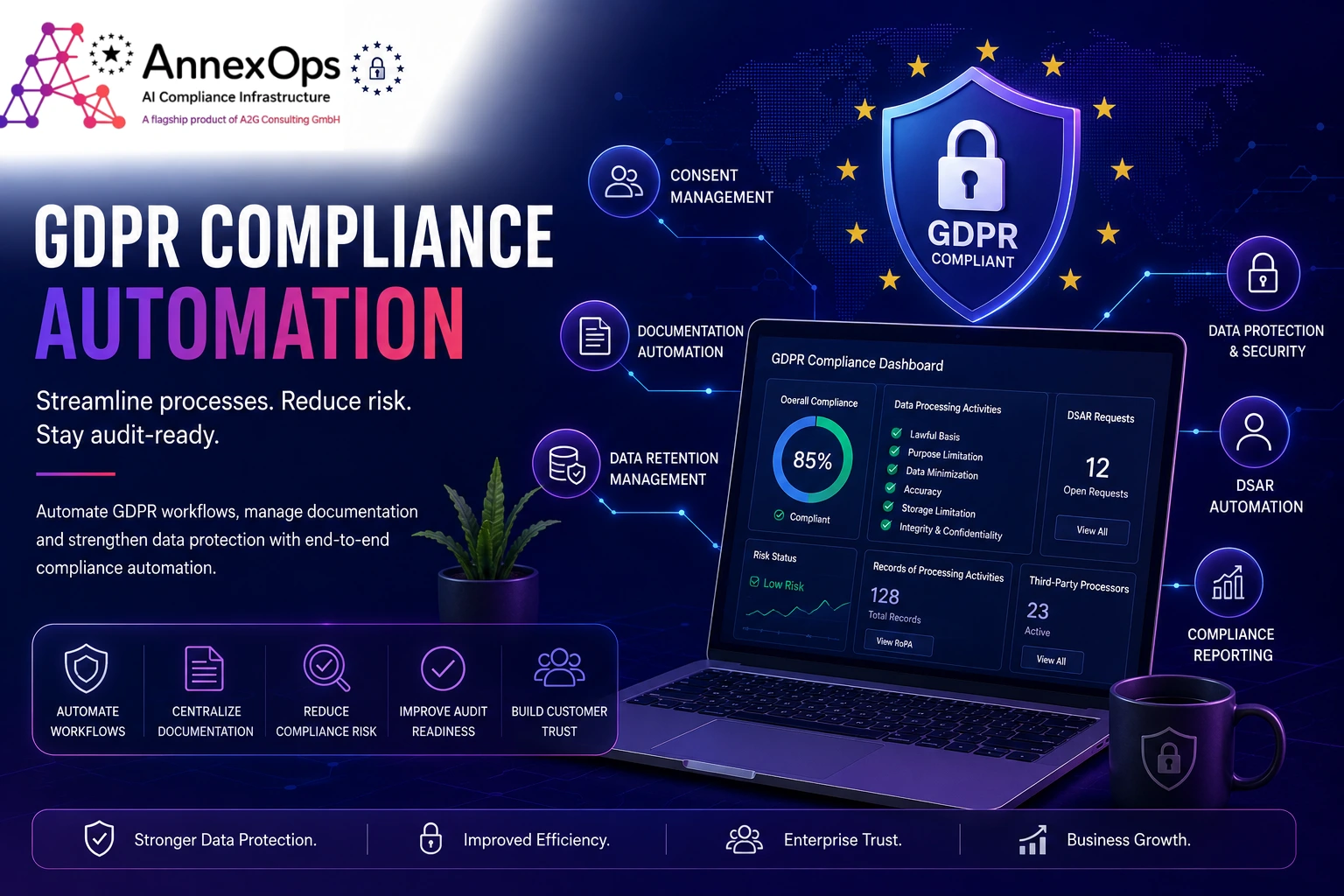
By automating documentation, governance workflows, AI Risk Management, and audit readiness, organizations can reduce manual effort, improve regulatory confidence, and build the operational foundation needed to scale Trustworthy AI.
For AI startups, SaaS providers, enterprise AI vendors, and product leaders, compliance is no longer just about avoiding regulatory penalties. Strong governance has become a competitive advantage that accelerates enterprise sales, builds customer trust, and prepares organizations for evolving regulations such as the EU AI Act, Annex IV documentation, and ongoing transparency requirements.
In this guide, we’ll explore what GDPR Compliance Automation is, why manual compliance is no longer sustainable, and how businesses can use automation to simplify compliance while preparing for the future of AI governance.
What Is GDPR Compliance Automation?
The General Data Protection Regulation (GDPR) is one of the world’s most comprehensive data privacy regulations. Introduced by the European Union, its primary purpose is to protect the personal data of individuals and ensure organizations collect, process, store, and share that data responsibly.
For businesses handling customer, employee, or partner information, GDPR requires much more than simply publishing a privacy policy. Organizations must demonstrate that they have processes in place to protect personal data, respond to user requests, maintain accurate records, and continuously monitor compliance.
While these responsibilities are manageable for small organizations, they become increasingly complex as businesses grow.
Imagine an AI company processing millions of customer interactions every month. Personal data flows through CRM systems, cloud platforms, HR software, customer support tools, marketing applications, and AI models. Managing compliance manually across all these systems quickly becomes inefficient and prone to errors.
This is where GDPR Compliance Automation becomes essential.
GDPR Compliance Automation refers to the use of software, structured workflows, and governance tools to automate repetitive compliance activities. Instead of relying on spreadsheets, emails, and manual documentation, organizations can centralize compliance processes, improve visibility, and reduce administrative effort.
Rather than replacing compliance teams, automation empowers them to focus on strategic decision-making instead of repetitive operational tasks.
Simply put, GDPR Compliance Automation helps organizations protect personal data more efficiently while reducing compliance risks and maintaining continuous audit readiness.
Why Businesses Need GDPR Compliance Automation
Many organizations initially manage GDPR compliance using manual processes.
Consent records are maintained in spreadsheets.
Data processing activities are documented in shared folders.
Approval requests are sent through email.
Audit evidence is collected only when regulators or customers ask for it.
This approach may work when a business is small.
But as organizations scale, so do their compliance responsibilities.
Every new customer, employee, AI application, third-party vendor, or cloud platform introduces additional data processing activities that must be tracked and governed.
Without automation, compliance teams often spend more time managing documentation than managing actual risk.
Some of the most common challenges include:
Disconnected Documentation
Compliance records are often spread across multiple systems, making it difficult to maintain a single source of truth.
Time-Consuming Manual Processes
Tasks such as updating processing records, reviewing policies, collecting evidence, and responding to Data Subject Access Requests (DSARs) require significant manual effort.
Increased Risk of Human Error
Missed updates, outdated records, and inconsistent documentation can expose organizations to unnecessary compliance risks.
Limited Visibility
Without centralized governance, leadership teams have little insight into compliance status, unresolved risks, or upcoming regulatory obligations.
Audit Pressure
Preparing for an audit often means gathering documents from multiple departments under tight deadlines, an approach that consumes valuable time and resources.
The more an organization grows, the harder it becomes to manage these responsibilities manually.
Automation transforms compliance from a reactive activity into an ongoing operational process.
Instead of asking, “Where is the latest version of this document?” teams can focus on more strategic questions such as:
- Are our governance controls effective?
- Which AI systems require additional oversight?
- Where are the highest compliance risks?
- Are we prepared for future regulatory changes?
This shift allows organizations to spend less time chasing documentation and more time building secure, trustworthy AI solutions.
Signs Your Organization Has Outgrown Manual Compliance
Many businesses don’t realize they have a compliance problem until an audit, enterprise customer, or regulator requests evidence.
If any of the following sound familiar, it may be time to consider GDPR Compliance Automation:
- Compliance documents are stored across multiple platforms.
- Teams rely heavily on spreadsheets and email for approvals.
- Audit preparation takes weeks instead of days.
- Compliance status is difficult to track across departments.
- AI projects lack centralized documentation.
- Governance activities depend on manual follow-ups.
- Responding to customer compliance questionnaires requires significant effort.
These operational inefficiencies don’t just slow compliance, they can delay enterprise deals, increase operational costs, and reduce customer confidence.
Ready to Move Beyond Manual Compliance?
If your organization is still relying on spreadsheets, disconnected documentation, or manual governance processes, it’s time to rethink how compliance is managed.
AnnexOps helps AI-driven organizations centralize documentation, streamline governance workflows, strengthen AI risk management, and stay audit-ready as regulatory expectations continue to evolve.
👉 Learn how AnnexOps helps organizations build scalable compliance operations:
📧 marketing@annexops.com
📞 +49 1522 2383606
Why GDPR Compliance Automation Is Becoming a Business Priority
Regulatory compliance is no longer driven solely by legal requirements.
Today, enterprise customers, investors, and business partners expect organizations to demonstrate mature governance before entering commercial relationships.
Security assessments, procurement reviews, and vendor due diligence increasingly include questions about how organizations manage personal data, document compliance activities, and govern AI systems.
Businesses that can provide clear, structured evidence often move through these processes more efficiently than those relying on manual documentation.
In other words, GDPR Compliance Automation is no longer just about avoiding penalties.
It helps organizations:
- Improve operational efficiency
- Strengthen customer trust
- Reduce compliance risk
- Accelerate enterprise procurement
- Prepare for future regulations like the EU AI Act
- Build a stronger foundation for AI Governance
Organizations that invest in compliance automation today aren’t simply meeting regulatory expectations, they’re creating a competitive advantage that supports long-term business growth.
What Can Be Automated Under GDPR?
One of the biggest misconceptions about GDPR is that compliance is entirely manual. While strategic decisions still require human expertise, many repetitive and time-consuming compliance tasks can be automated.
Automation doesn’t eliminate accountability, it helps organizations perform compliance activities more consistently, efficiently, and with fewer errors.
The following table highlights some of the most common GDPR processes that organizations are automating today.
| GDPR Requirement | Manual Process | Automated Process |
| Consent Management | Tracking consent through spreadsheets or emails | Automatically record, update, and manage consent preferences |
| Records of Processing Activities (RoPA) | Manually updating documents | Maintain centralized, real-time records |
| Data Subject Access Requests (DSARs) | Email-based request handling | Workflow-driven request tracking and fulfillment |
| Data Retention Policies | Manual reminders and reviews | Automated retention schedules and notifications |
| Risk Assessments | Separate spreadsheets and documents | Centralized risk tracking and governance workflows |
| Audit Evidence | Gathered only before an audit | Continuously collected and organized for audit readiness |
| Compliance Reporting | Manual reporting | Automated dashboards and compliance insights |
By automating these activities, organizations reduce administrative overhead while improving visibility across their compliance operations.
The Business Benefits of GDPR Compliance Automation
For many organizations, the biggest value of automation isn’t simply saving time, it’s creating a scalable compliance program that grows with the business.
As AI adoption increases and data volumes expand, compliance becomes an ongoing operational function rather than a one-time legal exercise.
Here are some of the most significant benefits organizations gain from GDPR Compliance Automation.
Improved Operational Efficiency
Manual compliance requires teams to repeatedly update documentation, collect evidence, coordinate approvals, and monitor regulatory obligations.
Automation eliminates much of this repetitive work, allowing legal, compliance, and engineering teams to focus on higher-value initiatives.
Better Visibility Across Compliance Activities
When compliance data is scattered across spreadsheets, emails, and multiple business applications, leadership lacks a clear picture of organizational risk.
Centralized governance provides better visibility into documentation, policies, compliance status, and unresolved issues.
Faster Audit Readiness
Audits shouldn’t trigger weeks of searching for documents.
Automation enables organizations to maintain evidence continuously, making regulatory reviews and customer due diligence significantly easier.
Reduced Human Error
Manual processes increase the likelihood of outdated records, inconsistent documentation, and missed compliance tasks.
Automation improves consistency by following predefined workflows and maintaining standardized records.
Stronger Customer and Enterprise Trust
Enterprise customers increasingly expect vendors to demonstrate mature governance practices before signing contracts.
Organizations that can quickly provide structured compliance evidence often build credibility faster during procurement and security reviews.
Better Collaboration Between Teams
GDPR compliance is no longer owned exclusively by legal teams.
Engineering, product management, security, IT, and compliance all contribute to governance.
Automation creates a shared operational framework that improves collaboration across departments.
Build Compliance That Scales With Your Business
Managing compliance manually becomes more difficult as your organization grows.
Discover how AnnexOps helps organizations centralize AI documentation, automate governance workflows, and simplify compliance operations without slowing innovation.
📧 marketing@annexops.com
📞 +49 1522 2383606
Common Challenges When Implementing GDPR Compliance Automation
Although automation offers significant advantages, implementing it successfully requires more than purchasing software.
Organizations often encounter operational challenges that must be addressed before automation can deliver meaningful results.
Disconnected Systems
Many businesses use multiple applications to manage customer data, employee records, cloud infrastructure, and AI systems.
Without centralized governance, compliance information remains fragmented.
Legacy Processes
Organizations that have relied on spreadsheets and manual documentation for years often struggle to transition to structured workflows.
Modernizing compliance requires both process improvements and cultural change.
Cross-Functional Coordination
GDPR compliance involves multiple stakeholders, including legal, compliance, engineering, product, and security teams.
Without clearly defined governance workflows, responsibilities can become unclear and inconsistent.
Rapidly Changing Regulations
Privacy regulations continue to evolve, while AI regulations such as the EU AI Act introduce additional governance expectations.
Organizations need compliance programs that can adapt rather than requiring complete redesign whenever regulations change.
Scaling AI Responsibly
As organizations deploy more AI-powered applications, governance responsibilities expand beyond personal data protection.
Documentation, monitoring, transparency, and risk management become increasingly important for maintaining trust and regulatory readiness.
These challenges demonstrate why compliance is no longer simply about documentation—it is about building operational processes that scale alongside business growth.
GDPR Compliance Automation Is the Foundation for Modern AI Governance
For AI-driven organizations, GDPR compliance is only one part of a broader governance strategy.
Businesses developing intelligent applications process personal data, make automated decisions, integrate machine learning models, and increasingly operate within complex regulatory environments.
This is where AI Governance becomes essential.
AI Governance provides the operational framework for managing how AI systems are developed, monitored, documented, and continuously improved.
While GDPR focuses on protecting personal data, AI Governance expands that responsibility by addressing questions such as:
- How are AI systems monitored over time?
- Are risks identified and documented throughout the AI lifecycle?
- Can organizations demonstrate transparency in AI-assisted decisions?
- Is there appropriate human oversight for high-impact AI systems?
- Are governance records available during an audit?
Organizations that automate GDPR compliance are already building many of the operational capabilities required to answer these questions.
For example:
- Centralized documentation supports both GDPR and AI Documentation requirements.
- Governance workflows improve accountability across compliance teams.
- Continuous monitoring strengthens AI Risk Management.
- Audit-ready records simplify regulatory reviews and enterprise due diligence.
As regulatory expectations continue to evolve, organizations that integrate privacy, governance, and compliance into a single operational framework will be better positioned to scale trustworthy AI while reducing long-term compliance risk.
Looking Beyond GDPR?
As AI regulations continue to evolve, organizations need governance processes that extend beyond traditional privacy compliance.
Learn how AnnexOps helps AI-driven businesses operationalize AI Governance, manage AI documentation, strengthen AI risk management, and prepare for evolving regulatory expectations with confidence.
📧 marketing@annexops.com
📞 +49 1522 2383606
Preparing for the Future: GDPR Compliance Is Just the Beginning
For organizations building AI-powered products, achieving GDPR compliance is an important milestone, but it shouldn’t be the final destination.
The regulatory landscape is evolving rapidly. As AI becomes more deeply embedded in business operations, governments and regulators are introducing new requirements that go beyond data privacy.
One of the most significant developments is the EU AI Act, which establishes a risk-based framework for governing AI systems across the European Union.
Unlike GDPR, which focuses on protecting personal data, the EU AI Act focuses on how AI systems are designed, developed, deployed, monitored, and governed throughout their lifecycle.
For AI startups, SaaS providers, and enterprise vendors, this means compliance is no longer limited to privacy policies and consent management. Organizations must also demonstrate responsible AI governance, operational transparency, and continuous oversight.
Businesses that already have automated GDPR compliance processes are in a much stronger position to adapt to these new requirements.
How GDPR Compliance Automation Supports AI Governance
Although GDPR and the EU AI Act are separate regulations, they share a common objective: building trust through responsible governance.
Organizations that automate GDPR compliance often establish the operational foundations needed for broader AI governance initiatives.
These capabilities include:
Centralized AI Documentation
Maintaining accurate, up-to-date documentation is essential for demonstrating accountability.
Instead of storing compliance records across multiple systems, organizations can centralize documentation, making it easier to manage regulatory obligations and respond to customer due diligence requests.
AI Risk Management
Responsible AI requires organizations to identify, assess, and mitigate risks throughout the AI lifecycle.
Structured governance workflows help ensure risks are documented, monitored, and reviewed consistently rather than addressed only during audits.
Continuous Monitoring
Compliance isn’t a one-time exercise.
AI systems evolve through model updates, new datasets, software releases, and changing business requirements.
Continuous monitoring helps organizations maintain governance as these systems change over time.
Human Oversight
Not every AI decision should operate without human involvement.
Organizations need clear governance processes that define when human review is required, particularly for high-impact or business-critical applications.
Audit Readiness
Whether responding to customer procurement reviews or preparing for a regulatory assessment, organizations benefit from having governance evidence readily available instead of collecting it at the last minute.
These operational practices help businesses build Trustworthy AI while reducing compliance complexity as regulations continue to evolve.
Operational Best Practices for Long-Term Compliance
Compliance shouldn’t be treated as an annual project or a collection of disconnected policies.
Organizations that scale successfully adopt governance as an ongoing operational capability.
Here are five best practices that help create a sustainable compliance framework.
1. Centralize Governance Information
Maintain policies, AI documentation, risk assessments, audit evidence, and compliance records within a single governance framework.
A centralized approach improves visibility and reduces duplication across teams.
2. Standardize Governance Workflows
Clearly defined workflows ensure compliance activities follow consistent processes, regardless of which department is responsible.
Standardization also improves accountability and simplifies future audits.
3. Monitor Compliance Continuously
Regulations, AI systems, and business operations change frequently.
Continuous monitoring allows organizations to identify compliance gaps early rather than discovering them during an audit.
4. Strengthen Cross-Functional Collaboration
Effective governance requires collaboration between legal, compliance, engineering, security, product, and executive leadership.
Shared workflows improve communication and reduce operational silos.
5. Prepare for Future Regulations
Compliance strategies should be designed to evolve.
Organizations that build scalable governance processes today will be better prepared for future regulatory requirements tomorrow.
How AnnexOps Helps Organizations Operationalize Compliance
Building a modern compliance program requires more than policies and checklists.
Organizations need operational infrastructure that enables governance at scale.
AnnexOps helps AI-driven organizations operationalize compliance by bringing governance activities into one structured environment.
Rather than relying on disconnected documents and manual tracking, organizations can manage compliance through:
- Structured governance workflows
- Centralized AI Documentation
- Continuous AI Risk Management
- Annex IV documentation management
- Compliance tracking across AI systems
- Governance monitoring
- Audit-ready evidence
- Cross-functional collaboration
This operational approach helps organizations reduce administrative effort while improving visibility into compliance activities.
Instead of treating compliance as a one-time legal requirement, AnnexOps enables businesses to embed governance into everyday operations, making it easier to adapt as regulations and AI systems evolve.
Whether your organization is preparing for enterprise procurement, strengthening internal governance, or working toward EU AI Act audit readiness, operationalizing compliance creates a stronger foundation for long-term success.
Ready to Move Beyond Manual Compliance?
Manual compliance processes may work for a small team, but they don’t scale with modern AI development.
AnnexOps helps organizations simplify compliance by centralizing documentation, streamlining governance workflows, strengthening AI risk management, and supporting continuous audit readiness.
Discover how AnnexOps can help your organization build scalable, future-ready AI compliance operations.
📧 marketing@annexops.com
📞 +49 1522 2383606
Conclusion
Compliance is no longer just about avoiding penalties, it’s about building trust, improving operational efficiency, and enabling sustainable business growth.
As organizations process larger volumes of personal data and deploy increasingly sophisticated AI systems, manual compliance methods become difficult to maintain. Spreadsheets, email approvals, and disconnected documentation may meet short-term needs, but they cannot support the level of governance modern businesses require.
GDPR Compliance Automation helps organizations replace fragmented processes with structured workflows that improve visibility, reduce administrative effort, and strengthen accountability.
At the same time, it creates the operational foundation needed for broader AI Governance, helping organizations prepare for evolving requirements such as the EU AI Act, AI Risk Management, Annex IV documentation, transparency obligations, and continuous monitoring.
Organizations that invest in compliance automation today won’t just be better prepared for tomorrow’s regulations, they’ll also be better positioned to earn customer trust, accelerate enterprise sales, and scale AI responsibly.
Transform Compliance Into a Competitive Advantage
The organizations leading the next generation of AI innovation understand that governance isn’t a barrier to growth, it’s what makes sustainable growth possible.
If your compliance program still depends on manual documentation, disconnected workflows, or reactive audit preparation, now is the time to modernize your approach.
With AnnexOps, you can:
✅ Centralize AI Documentation
✅ Automate Governance Workflows
✅ Strengthen AI Risk Management
✅ Simplify Annex IV Documentation
✅ Improve EU AI Act Audit Readiness
✅ Build Trustworthy AI at Scale
Learn how AnnexOps helps AI-driven companies prepare for the EU AI Act with clarity and confidence.
🌐 https://annexops.com/
📧 marketing@annexops.com
📞 +49 1522 2383606
Frequently Asked Questions
What is GDPR Compliance Automation?
GDPR Compliance Automation is the use of software and automated workflows to streamline GDPR-related activities such as consent management, documentation, Records of Processing Activities (RoPA), Data Subject Access Requests (DSARs), audit preparation, and compliance monitoring.
Why should organizations automate GDPR compliance?
Automation reduces manual effort, improves accuracy, minimizes compliance risks, strengthens audit readiness, and enables organizations to manage GDPR requirements more efficiently as they grow.
Can GDPR Compliance Automation help AI companies?
Yes. AI companies often process large volumes of personal data while managing complex governance requirements. Automation helps centralize documentation, improve AI risk management, and create a stronger foundation for responsible AI development.
How is GDPR different from the EU AI Act?
GDPR focuses on protecting personal data and individual privacy. The EU AI Act regulates how AI systems are designed, deployed, monitored, and governed based on their level of risk. Organizations developing AI solutions may need to comply with both regulations.
What is Annex IV documentation?
Annex IV documentation is a technical documentation requirement under the EU AI Act for certain high-risk AI systems. It provides evidence that AI systems meet governance, transparency, and compliance requirements.
How does AnnexOps support AI compliance?
AnnexOps helps organizations operationalize AI compliance through centralized AI documentation, structured governance workflows, AI risk management, continuous monitoring, Annex IV documentation management, and audit-ready compliance operations, helping businesses scale AI responsibly while preparing for evolving regulatory requirements.
Author: Nitin Grover
Nitin Grover is an AI compliance strategist and writer focused on EU AI Act compliance, AI governance, Annex IV documentation, AI risk management, and AI compliance operations for AI startups, SaaS companies, and enterprise AI teams across Europe.